
Planetary and lunar rover exploration missions can encounter environments that do not allow for navigation by typical, stereo camera-based systems. Stereo cameras meet difficulties in areas with low ambient light (even when lit by floodlights), direct sunlight, or washed-out environments. Improved sensors are required for safe and successful rover mobility in harsh conditions. NASA Goddard Space Flight Center has developed a Space Qualified Rover LiDAR (SQRLi) system that will improve rover sensing capabilities in a small, lightweight package. The new SQRLi package is developed to survive the hazardous space environment and provide valuable image data during planetary and lunar rover exploration.
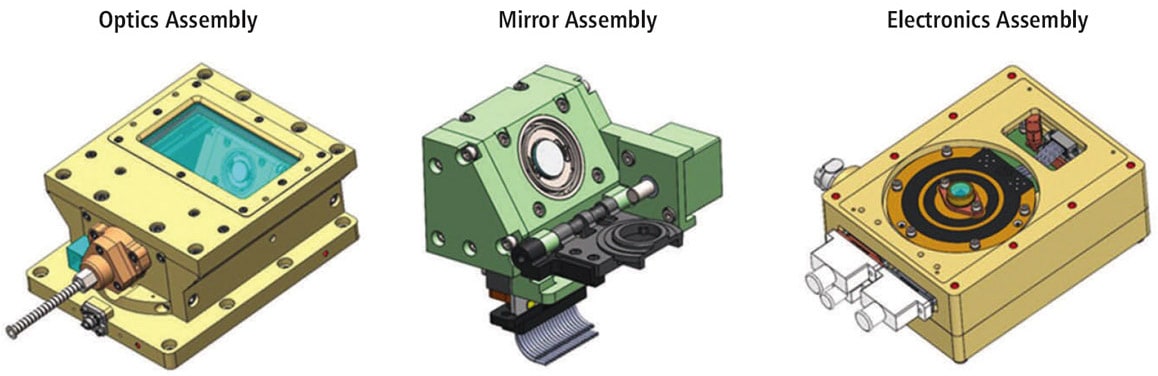
The SQRLi system is made up of three major components including the laser assembly, the mirror assembly, and the electronics and data processing equipment (electronics assembly) as shown in the figure. The three main systems work together to send and receive the lidar signal then translate it into a 3D image for navigation and imaging purposes. The rover sensing instrument makes use of a unique fiber optic laser assembly with high, adjustable output that increases the dynamic range (i.e., contrast) of the lidar system.
The commercially available mirror setup used in the SQRLi is small, reliable, and has a wide aperture that improves the field-of-view of the lidar while maintaining a small instrument footprint. Lastly, the data processing is done by an in-house designed processor capable of translating the light signal into a high-resolution (sub-millimeter) 3D map. These components of the SQRLi enable successful hazard detection and navigation in visibility-impaired environments.
The SQRLi is applicable to planetary and lunar exploration by unmanned or crewed vehicles and may be adapted for in-space servicing, assembly, and manufacturing purposes. Beyond NASA missions, the new 3D LiDAR may be used for vehicular navigation in the automotive, defense, or commercial space sectors.
NASA is actively seeking licensees to commercialize this technology. Please contact NASA’s Licensing Concierge at