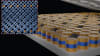

The purpose of this program was to develop single-photon-sensitive shortwavelength infrared (SWIR) and midwavelength infrared (MWIR) avalanche photodiode (APD) receivers based on linear-mode HgCdTe APDs, for application by NASA in light detection and ranging (lidar) sensors. Linear-mode photon-counting APDs are desired for lidar because they have a shorter pixel dead time than Geiger APDs, and can detect sequential pulse returns from multiple objects that are closely spaced in range. Linear-mode APDs can also measure photon number, which Geiger APDs cannot, adding an extra dimension to lidar scene data for multi-photon returns. High-gain APDs with low multiplication noise are required for efficient linear-mode detection of single photons because of APD gain statistics — a low-excess- noise APD will generate detectible current pulses from single photon input at a much higher rate of occurrence than will a noisy APD operated at the same average gain. MWIR and LWIR electron-avalanche HgCdTe APDs have been shown to operate in linear mode at high average avalanche gain (M > 1000) without excess multiplication noise (F = 1), and are therefore very good candidates for linear-mode photon counting. However, detectors fashioned from these narrow-bandgap alloys require aggressive cooling to control thermal dark current. Wider-bandgap SWIR HgCdTe APDs were investigated in this program as a strategy to reduce detector cooling requirements.
The first objective was to build SWIR HgCdTe APDs, and to assess their suitability for photon counting in linear mode. The second objective was to implement manufacturing improvements to mitigate surface dark current, improve reliability, and eliminate peaking in the spectral response.
Voxtel manufactured and characterized 2.7-μm-cutoff HgCdTe APDs, publishing excess noise data taken at the highest avalanche gain levels yet demonstrated for SWIR HgCdTe APDs (M = 80). Quantum efficiency was limited to approximately 73% at 1,550 nm by partial reflection from the non-coated optical entrance surface; quantum efficiency near 94% is expected for these devices if an anti-reflection coating is used. Excellent yield of operable APD pixels and uniformity of APD response were both obtained, but the maximum avalanche gain that could be achieved with SWIR-cutoff material was deemed too low to enable single-photon detection. Comparison of Voxtel’s maximum gain measurements suggests that this is an inherent material limitation of the SWIR alloy. Room-temperature responsivity of about 5 kV/W and noise-equivalent power (NEP) of 33.3 nW were measured at 1550 nm when the APD operated at a gain of M=6.6.
Completion of development of CdTe surface passivation for MWIR HgCdTe APDs presents the best opportunity to further improve receiver sensitivity, as it will enable operation at much higher avalanche gain with reduced dark current. This innovation can find use with quantum information (encryption and basic science), semiconductor inspection, and molecular spectroscopy.
This work was done by Andrew Huntington of Voxtel, Inc. for Goddard Space Flight Center. GSC-16140-1