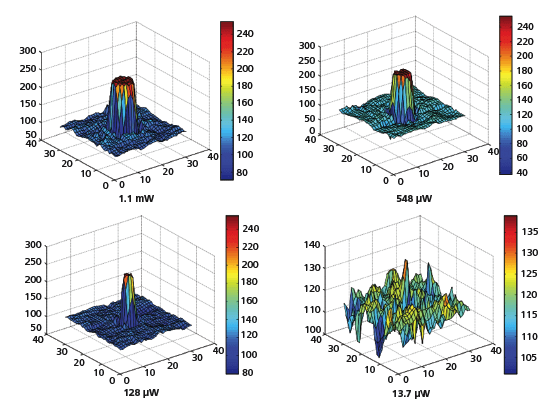
A new optical beam tracking approach for free-space optical communication links using two-photon absorption (TPA) in a high-bandgap detector material was demonstrated. This tracking scheme is part of the canonical architecture described in the preceding article. TPA is used to track a long-wavelength transmit laser while direct absorption on the same sensor simultaneously tracks a shorter-wavelength beacon. The TPA responsivity was measured for silicon using a PIN photodiode at a laser beacon wavelength of 1,550 nm. As expected, the responsivity shows a linear dependence with incident power level. The responsivity slope is 4.5 × 10⁻⁷ A/W2. Also, optical beam spots from the 1,550-nm laser beacon were characterized on commercial charge-coupled device (CCD) and complementary metal-oxide semiconductor (CMOS) imagers with as little as 13.7 μW of optical power (see figure). This new tracker technology offers an innovative solution to reduce system complexity, improve transmit/receive isolation, improve optical efficiency, improve signal-to-noise ratio (SNR), and reduce cost for free-space optical communications transceivers.
This work was done by Gerardo G. Ortiz and William H. Farr of Caltech for NASA’s Jet Propulsion Laboratory. For more information, download the Technical Support Package (free white paper) at www.techbriefs.com/tsp under the Physical Sciences category. NPO-46063
This Brief includes a Technical Support Package (TSP).
Two-Photon-Absorption Scheme for Optical Beam Tracking
(reference NPO-46063) is currently available for download from the TSP library.
Don't have an account?
Overview
The document titled "Two-Photon Absorption Long Wavelength Optical Beam Tracking" by Gerardo G. Ortiz, prepared for the Jet Propulsion Laboratory (JPL) at the California Institute of Technology, discusses a novel technology aimed at enhancing optical beam tracking systems, particularly for space communication applications.
The core of the document revolves around the two-photon absorption process, which is a significant advancement in optical communication technology. This method allows for improved detection and tracking of optical signals over long distances, which is crucial for deep space missions. The technology is particularly relevant to NASA's ongoing efforts to develop free-space optical communication systems, which are essential for efficient data transmission between spacecraft and ground stations.
One of the key highlights of this technology is its potential to reduce complexity and costs associated with optical beam tracking systems. The document contrasts this new approach with the previously proposed Mars Laser Communications Demonstration Project, which was ultimately canceled. The two-photon absorption technology is being integrated into a next-generation deep space optical communication prototype terminal for Mars, developed by JPL’s Optical Communication Group. Additionally, it is being considered for various applications, including Earth orbiters, lunar optical transceivers, and planetary orbiters.
The document also outlines the technical aspects of the two-photon absorption process, detailing the experimental setups involving silicon PIN detectors, CCD cameras, and CMOS cameras. These components are critical for the successful implementation of the technology in real-world applications.
Furthermore, the document emphasizes the broader implications of this research, suggesting that the advancements in optical beam tracking could lead to significant improvements in communication capabilities for future space missions. The technology not only promises to enhance the efficiency of data transmission but also aims to facilitate more complex and ambitious space exploration endeavors.
In summary, this document serves as a comprehensive overview of the two-photon absorption technology, its relevance to NASA's projects, and its potential to revolutionize optical communication in space. It highlights the ongoing research and development efforts at JPL and underscores the importance of innovative technologies in advancing aerospace capabilities.