

Inside this issue
Supplements

Overview
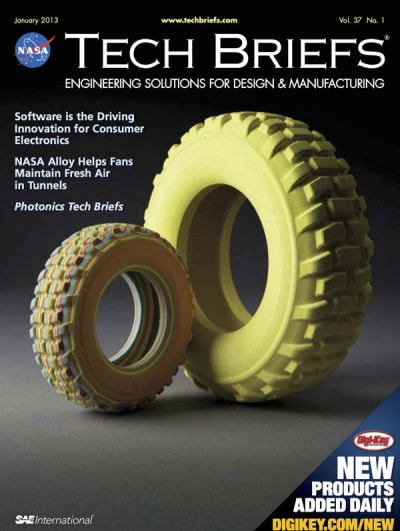
The January 2013 edition of NASA Tech Briefs and Photonics Tech Briefs presents a wealth of information on the latest advancements in technology, particularly in the fields of consumer electronics, photonics, and aerospace. This issue highlights innovative solutions and products that are shaping the future of these industries.
Key Highlights:
-
Software Innovations in Consumer Electronics: The issue opens with a discussion on how software is driving innovation in consumer electronics. It emphasizes the importance of software development in enhancing user experience and functionality in devices, showcasing how companies are leveraging software to create smarter, more efficient products.
-
NASA Alloy for Air Quality: A notable feature discusses a NASA-developed alloy that helps maintain fresh air in tunnels. This technology is crucial for ensuring air quality in confined spaces, particularly in urban environments where air pollution can be a significant concern. The alloy's properties allow for effective ventilation and air circulation, contributing to healthier living conditions.
-
Photonics Technology: The magazine delves into various photonics technologies, including trends in fused components for fiber lasers. These advancements are critical for improving the performance and efficiency of laser systems used in a variety of applications, from telecommunications to medical devices.
-
Design Automation in Photonics: Another article focuses on photonics design automation, which streamlines the design process for photonic devices. This technology enables engineers to create more complex and efficient designs, reducing development time and costs while enhancing performance.
Ultra-Compact Spectrometers: The issue features an ultra-compact, superconducting spectrometer-on-a-chip designed for submillimeter wavelengths. This innovative device represents a significant leap in spectroscopic technology, allowing for more precise measurements in various scientific fields, including astronomy and environmental monitoring.
-
Rad-Tolerant Fiber-Optic Networks: The magazine also covers the development of rad-tolerant, thermally stable, high-speed fiber-optic networks designed for harsh environments. These networks are essential for applications in space exploration and other extreme conditions, ensuring reliable communication and data transmission.
-
UV Resonant Raman Spectrometer: A UV resonant Raman spectrometer with multi-line laser excitation is highlighted for its ability to provide detailed molecular analysis. This technology is particularly useful in chemical and material sciences, offering insights into molecular structures and interactions.
-
Subsurface Optical Communications: The issue discusses a towed subsurface optical communications buoy, which enhances underwater communication capabilities. This technology is vital for marine research and military applications, allowing for better data transmission in challenging underwater environments.
-
Fluorescence Detection Cells: The magazine features high-collection-efficiency fluorescence detection cells, which improve the sensitivity and accuracy of fluorescence measurements. These cells are crucial for various applications, including biomedical research and environmental monitoring.
-
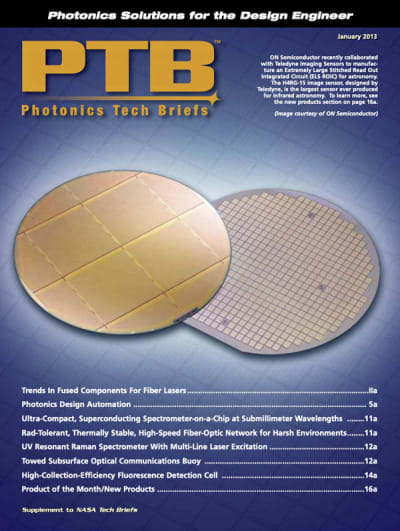
Product Innovations: The "Product of the Month" section showcases new products, including the Extremely Large Stitched Read Out Integrated Circuit (ELS ROIC) developed by ON Semiconductor in collaboration with Teledyne Imaging Sensors. This image sensor is the largest ever produced for infrared astronomy, marking a significant milestone in astronomical imaging technology.
-
Advertisers Index: The issue concludes with an advertisers index, providing readers with resources to access product literature and additional information from featured companies.
Conclusion: The January 2013 edition of NASA Tech Briefs and Photonics Tech Briefs serves as a comprehensive resource for professionals and enthusiasts in the fields of technology and photonics. It highlights significant advancements and innovations that are shaping the future of these industries, offering insights into the latest research, products, and applications. The magazine not only showcases cutting-edge technologies but also emphasizes the importance of collaboration and innovation in driving progress across various sectors. Readers are encouraged to explore the articles and utilize the provided resources to stay informed about the latest developments in technology.
Features
-
Application Briefs
-
Who's Who
Chuck Jorgensen, Chief Scientist for Neuro Engineering, Ames Research Center, Moffett Field, CA
Tech Briefs
-
Physical Sciences
Single-Photon-Sensitive HgCdTe Avalanche Photodiode Detector
Surface-Enhanced Raman Scattering Using Silica Whispering- Gallery Mode Resonators
Color-Changing Sensors for Detecting the Presence of Hypergolic Fuels
Wind-Driven Wireless Networked System of Mobile Sensors for Mars Exploration
Analysis of the Effects of Streamwise Lift Distribution on Sonic Boom Signature
-
Manufacturing & Prototyping
Microwave Sinterator Freeform Additive Construction System (MS-FACS)
Development of a Centrifugal Technique for the Microbial Bioburden Analysis of Freon (CFC-11)
-
Software
Artificial Intelligence Software for Assessing Postural Stability
System for Contributing and Discovering Derived Mission and Science Data
Remote Viewer for Maritime Robotics Software
Reachability Maps for In Situ Operations
JPL Space Telecommunications Radio System Operating Environment
RFI-SIM: RFI Simulation Package
IMPaCT — Integration of Missions, Programs, and Core Technologies
-
Materials
Using Pre-Melted Phase Change Material to Keep Payloads in Space Warm for Hours Without Power
Fibrillar Adhesive for Climbing Robots
Transformers: Shape-Changing Space Systems Built With Robotic Textiles
-
Information Sciences
3D Hail Size Distribution Interpolation/Extrapolation Algorithm
Estimating Torque Imparted on Spacecraft Using Telemetry
flexplan: Mission Planning System for the Lunar Reconnaissance Orbiter
Airborne Tomographic Swath Ice Sounding Processing System
PowderSim: Lagrangian Discrete and Mesh-Free Continuum Simulation Code for Cohesive Soils
Basic Operational Robotics Instructional System
Multiple-Frame Detection of Subpixel Targets in Thermal Image Sequences
-
Mechanics & Machinery
Ultra-Compact Transputer-Based Controller for High-Level, Multi-Axis Coordination
Regolith Advanced Surface Systems Operations Robot Excavator
-
Electronics & Computers
DSP/FPGA Design for a High-Speed Programmable S-Band Space Transceiver
Memory Circuit Fault Simulator
On-Chip Power-Combining for High-Power Schottky Diode- Based Frequency Multipliers
-
Briefs
Ultra-Compact, Superconducting Spectrometer-on-a-Chip at Submillimeter Wavelengths
Rad-Tolerant, Thermally Stable, High-Speed Fiber-Optic Network for Harsh Environments
UV Resonant Raman Spectrometer With Multi-Line Laser Excitation
-
Briefs
Photons Emitted by Quantum Dots Can be Made Indistinguishable Through Quantum Frequency Conversion
Self-Assembled Monolayers Create P-N Junctions in Graphene Films
New Platform Developed to Measure and Exploit Optomechanical Interactions











