

A system that includes sensors and data-acquisition, wireless data- communication, and data-processing subsystems has been developed as a means of both real-time and historical tracking of information indicative of deterioration in the mechanical integrity and performance of a high-geared ball valve or a linearly actuated valve that operates at a temperature between cryogenic and ambient.
The data collected in the original application include the number of cryogenic valve cycles, the total number of all valve cycles, inlet temperature, outlet temperature, valve-body temperature, torsional strain, linear strain, valve preload position, total rotational or linear valve travel, and total number of directional changes. Events associated with the aforementioned data are recorded and are time-stamped with sufficient precision to enable synchronization within a time increment of 1 ms. The data are then organized into a text file and stored in a compact flash memory card, from whence the data can be uploaded.
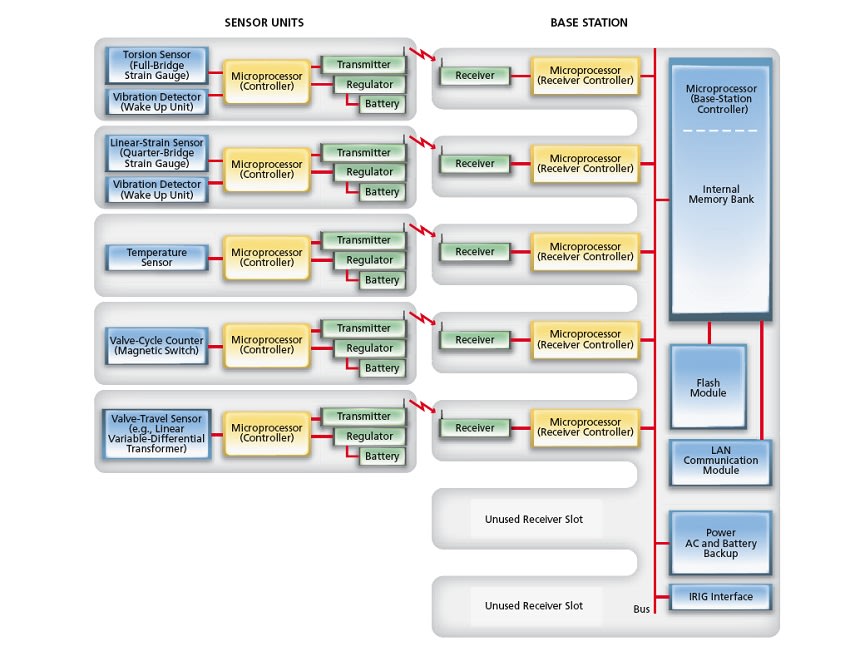
The system (see figure) includes a base station and several self-contained, microprocessor-controlled sensor units that (1) can be mounted remotely from the base station and (2) transmit data to the base station via low-power, short-range [≤ 35 ft (up to about 10 m)] digital radio communication links in the frequency band from 902 to 928 MHz. Each sensor unit has overall dimensions of 3 by 2 1/2 by 2 in. (about 7.6 by 6.4 by 5.1 cm) — small enough to be mounted in the confined spaces typically available for mounting on valves of the type used in the original rocket-engine-testing application. Each sensor unit is potted in a flame-retardant epoxy and designed to draw a current of no more than 0.25 A at a supply potential of 9 V, as required for safe operation in an atmosphere that may contain hydrogen. The base station is not potted; instead, it is mounted in an enclosure that is purged with nitrogen.
Each sensor unit contains two changeable battery packs and a voltage regulator that enables bumpless transfer of the load from one battery pack to the other. The temperatures of the battery packs and the microprocessor are monitored to safeguard against operation outside temperature limits. Each sensor unit includes a display-and-control panel through which a human technician can effect setup and can receive a low-battery indication. An interface port for onboard programming and serial communication is also provided. In the case of a strain-sensor unit, to minimize time-average power demand and thereby prolong battery life, the microprocessor is designed to spend most of the time in a low-power sleep mode, from which it is awakened when any valve movement is detected by a highly sensitive piezoelectric vibration-detection subunit.
The base station includes a receiver module, for each sensor unit, comprising a radio receiver and an associated microprocessor. The base station also includes another microprocessor that serves as the base-station controller, a compact flash module comprising the aforementioned flash memory card and its controller, a local-area-network (LAN) communication module, a power supply with battery backup, and an interface to a source of time-stamp signals that conform to an Inter Range Instrumentation Group (IRIG) standard. The base-station controller correlates related data from the sensor units and generates data-event log entries, which are transferred to the compact flash module. In addition, if the system is connected into a network, these log entries can be transferred to the LAN communication module for broadcasting over the network. The compact flash module can be manually removed to obtain access to the data stored therein.
Each receiver module maintains communications and time synchronization. It relays, to the base-station controller, information on events correlated with sensory and diagnostic information from its sensor unit. Each receiver module includes an interface port for onboard programming and serial communication with a mobile computer.
This work was done by Scott L. Jensen of Stennis Space Center and George J. Drouant of Jacobs Technology.
Inquiries concerning this technology should be addressed to the Intellectual Property Manager at Stennis Space Center (228) 688- 1929. SSC-00247-1










