A relatively inexpensive instrumentation system that includes units that are connected to thermocouples and that are parts of a radio-communication network has been developed to enable monitoring of temperatures at multiple locations. Because there is no need to string wires or cables for communication, the system is well suited for monitoring temperatures at remote locations and for applications in which frequent changes of monitored or monitoring locations are needed. The system can also be adapted to monitoring of slowly varying physical quantities, other than temperature, that can be transduced by solid-state electronic sensors.
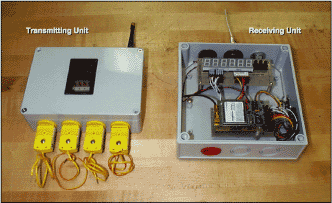
The system comprises any number of transmitting units and a single receiving unit (see figure). Each transmitting unit includes connections for as many as four external thermocouples, a signal-conditioning module, a control module, and a
radio-communication module. The signal-conditioning module acts as an interface between the thermocouples and the rest of the transmitting unit and includes a built-in solid ambient-temperature sensor that is in addition to the external thermocouples. The control module is a "system-on-chip" embedded processor that includes analog-to-digital converters, serial and parallel data ports, and an interface for local connection to an analog meter that is used during installation to verify correct operation. The radio-communication module contains a commercial spread-spectrum transceiver that operates in the 900-MHz industrial, scientific, and medical (ISM) frequency band. This transceiver transmits data to the receiving unit at a rate of 19,200 baud.
The receiving unit includes a transceiver like that of a transmitting unit, plus a control module that contains a system-on-chip processor that includes serial data port for output to a computer that runs monitoring and/or control software, a parallel data port for output to a printer, and a seven-segment light-emitting-diode display.
Each transmitting unit is battery-powered and can operate for at least seven days continuously while reporting temperatures every half hour. The receiving unit is powered by a wall-mounted transformer source. The receiving unit responds to each transmitting unit and reports the readings of each of the four thermocouples and of the ambient-temperature sensor of the transmitting unit. The end-to-end accuracy of the system is ±0.2 °C over the temperature range from 0 to 100 °C. The radio-communication range between the receiving and transmitting units is Å0.5 mile (Å0.8 km).
A Transmitting Unit (One of Several) and the Receiving Unit communicate by spread-spectrum modulation at a carrier frequency near 900 MHz. The use of spread-spectrum modulation minimizes interference to other radio-communication systems.
This work was done by Wanda Solano and Chuck Thurman of Stennis Space Center.
Inquiries concerning rights for the commercial use of this invention should be addressed to:
the Intellectual Property Manager
Stennis Space Center; (228) 688-1929.
Refer to SSC-00163.