
Mapping Capacitive Coupling Among Pixels in a Sensor Array
NASA’s Jet Propulsion Laboratory, Pasadena, California
Friday, January 01 2010
advertisement:
Cross-talk calibration of all pixels can be performed efficiently.
An improved method of mapping the
capacitive contribution to cross-talk
among pixels in an imaging array of sensors
(typically, an imaging photodetector
array) has been devised for use in calibrating
and/or characterizing such an array.
The method is applicable to almost all
image detectors in modern electronic
cameras for diverse applications, ranging
from consumer cellular-telephone cameras
at one extreme to high-performance
imaging scientific instruments at the other
extreme. In comparison with prior methods
of quantifying the capacitive coupling
among pixels, this method is a more efficient
means of obtaining detailed information
pertaining to all the pixels. Unlike the
prior methods, this method does not
require flat-field illumination of the array:
indeed, the method does not require any
illumination.
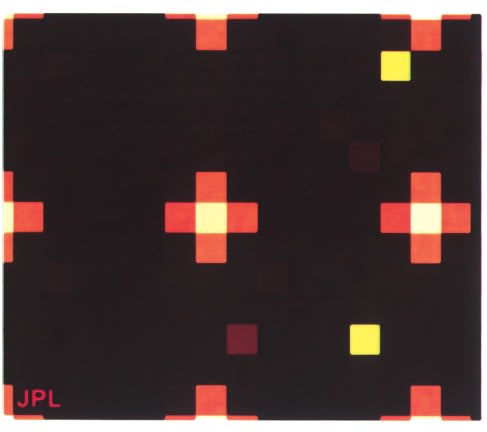
This Difference Image from a portion of an image detector containing arectangular pixel array was generated from two images: one recordedimmediately after and one recorded immediately before the second reset.The second-reset pixels were those residing at intersections of rows andcolumns at seven-pixel intervals.
The method involves a sequence of
resets of subarrays of pixels to specified
voltages and measurement of the voltage
responses of neighboring non-reset pixels.
The spacing of the reset pixels is
chosen in accordance with the number
of neighboring pixels over which the
coupling coefficients are sought. The
sequence begins with reset of all the pixels
in the array to a specified first voltage
level. In the next step, a subarray of pixels
is reset to a specified second voltage
level. Signals consisting of portions of
the second reset voltage change are coupled
capacitively from the pixels of the
reset subarray to adjacent non-secondreset
pixels. These signals can be
mapped in the form of difference
images from the pixel voltages measured
immediately before and immediately
after the second reset (see figure). The
sequence as described thus far can be
repeated for different subarrays of pixels,
as needed, to acquire data for characterizing
all pixels of interest. The
entire sequence can be repeated to acquire multiple sets of data that can be combined to reduce
measurement noise.
This work was done by Suresh Seshadri, David M. Cole, and Roger
M. Smith of Caltech for NASA’s Jet Propulsion Laboratory.
In accordance with Public Law 96-517, the contractor has elected to
retain title to this invention. Inquiries concerning rights for its commercial
use should be addressed to:
Innovative Technology Assets Management
JPL
Mail Stop 202-233
4800 Oak Grove Drive
Pasadena, CA 91109-8099
E-mail:
This e-mail address is being protected from spambots. You need JavaScript enabled to view it
Refer to NPO-45223, volume and number of this NASA Tech
Briefs issue, and the page number.
Subscribe today to receive the INSIDER, a FREE e-mail newsletter from NASA Tech Briefs featuring exclusive previews of upcoming articles, late breaking NASA and industry news, hot products and design ideas, links to online resources, and much more.



