

The figure depicts the planned Actuated Hybrid Mirror Telescope (AHMT), which is intended to demonstrate a new approach to the design and construction of wide-aperture spaceborne telescopes for astronomy and Earth science. This technology is also appropriate for Earth-based telescopes.
The new approach can be broadly summarized as using advanced lightweight mirrors that can be manufactured rapidly at relatively low cost. More specifically, it is planned to use precise replicated metallic nanolaminate mirrors to obtain the required high-quality optical finishes. Lightweight, dimensionally stable silicon carbide (SiC) structures will support the nanolaminate mirrors in the required surface figures. To enable diffraction-limited telescope performance, errors in surface figures will be corrected by use of mirror-shape-control actuators that will be energized, as needed, by a wave-front-sensing and control system.
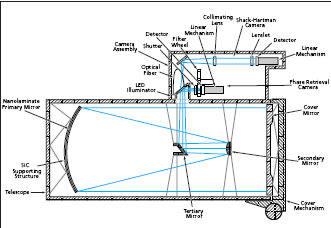
Each nanolaminate mirror will be bonded to its lightweight SiC supporting structure. The lightweight nanolaminate mirrors and SiC supporting structures will be fabricated from reusable master molds. The mirror-shape-control actuators will be low-power, high-capacitance lead magnesium niobate electrostrictive actuators that will be embedded in the SiC structures. The mode of operation of these actuators will be such that once power was applied, they will change in length and once power was removed, they will maintain dimensional stability to nanometer precision. This mode of operation will enable the use of low-power, minimally complex electronic control circuitry.
The wave-front-sensing and control system will be designed and built according to a two-stage architecture. The first stage will be implemented by a Shack-Hartmann (SH) sensor subsystem, which will provide a large capture range. The second, higher-performance stage will be implemented by an image based wave-front-sensing subsystem that will include a phase retrieval camera (PRC), and will utilize phase retrieval and other techniques to measure wavefront error directly. Phase retrieval is a process in which multiple images of an unresolved object are iterated to estimate the phase of the optical system that acquired the images. The combination of SH and phase retrieval sensors will afford the virtues of both a dynamic range of 105 and an accuracy of <10 nm.
This work was done by Gregory Hickey, David Redding, Andrew Lowman, David Cohen, and Catherine Ohara of Caltech for NASA's Jet Propulsion Laboratory. For further information, access the Technical Support Package (TSP) free on-line at www.techbriefs.com/tsp under the Physical Sciences category. NPO-40105
This Brief includes a Technical Support Package (TSP).
Actuated Hybrid Mirror Telescope;
(reference NPO-40105) is currently available for download from the TSP library.
Don't have an account?
Overview
The Actuated Hybrid Mirror Telescope (AHMT) project is a collaborative initiative under the X-Sat program of the National Reconnaissance Office (NRO), aimed at developing and validating a new type of space telescope that utilizes advanced optical technologies. Managed by the National Aeronautics and Space Administration (NASA) and conducted by institutions such as the Jet Propulsion Laboratory (JPL), Lawrence Livermore National Laboratory (LLNL), and Xinetics, Inc., the project focuses on creating lightweight, low-cost optics that can achieve high performance in space.
The AHMT features several key technologies, including precision replicated metallic nanolaminate mirrors, a silicon carbide (SiC) structure for optical stability, high-precision actuators for figure correction, and advanced wavefront sensing and control systems. These innovations are designed to ensure that the telescope can maintain optical quality and achieve diffraction-limited performance, even in the challenging microgravity environment of space.
The project plans to demonstrate these technologies during a shuttle flight in 2006, where a 0.75-meter diameter actuated hybrid primary mirror will be tested as a secondary payload. The testing will occur in two phases: the first phase will involve metrology with the external door closed, using an internal light source to measure and correct the mirror's figure. The second phase will expose the telescope to the space environment, allowing for imagery of Earth and celestial objects to evaluate image quality.
Nanolaminate materials, a significant aspect of the AHMT, are engineered to achieve high strength and stiffness while being lightweight. These materials are created through magnetron sputtering deposition, allowing for precise control over layer thickness and crystallographic texture, which is crucial for optical performance.
The wavefront sensing and control system is designed to measure and compensate for any figure errors that may arise post-launch, ensuring the telescope's performance remains optimal. The AHMT project not only aims to advance space telescope technology but also has potential applications in various fields, including aerospace and commercial technology.
Overall, the AHMT represents a significant step forward in the development of space optics, combining innovative materials and technologies to enhance the capabilities of future space telescopes.











