Inside this issue
Supplements

Overview
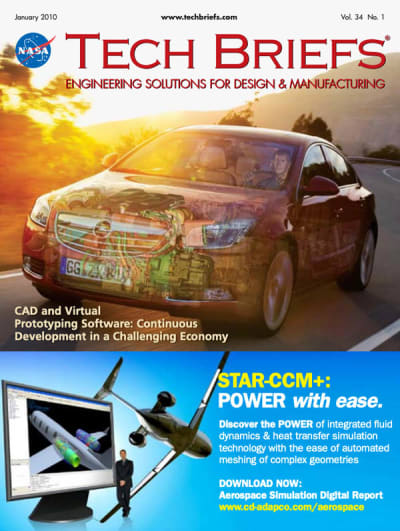
The January 2010 issue of NASA Tech Briefs, along with its supplements Photonics Tech Briefs and Embedded Technology, presents a comprehensive overview of advancements in technology, particularly focusing on innovations relevant to aerospace, photonics, and embedded systems. This edition highlights the continuous development of CAD and virtual prototyping software, which is crucial for design engineers navigating a challenging economic landscape.
Key Highlights:
-
CAD and Virtual Prototyping Software: The issue opens with an exploration of CAD and virtual prototyping software, emphasizing its importance in modern engineering. As industries face economic challenges, the continuous development of these tools allows for more efficient design processes, reducing costs and time-to-market for new products. The article discusses how these technologies enable engineers to create and test designs in a virtual environment, minimizing the need for physical prototypes.
-
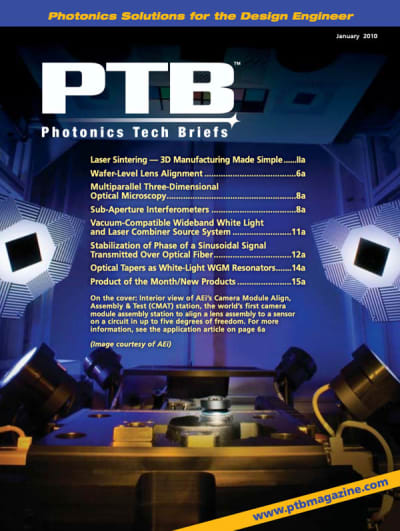
Photonics Innovations: The Photonics Tech Briefs section features several groundbreaking technologies:
- Laser Sintering: This technique simplifies 3D manufacturing, allowing for the creation of complex geometries that are difficult to achieve with traditional methods. The article discusses its applications in various industries, including aerospace and medical devices.
- Wafer-Level Lens Alignment: This technology is crucial for the production of high-performance optical systems. The article details the advancements in lens alignment processes that enhance the precision and efficiency of camera module assembly.
- Multiparallel Three-Dimensional Optical Microscopy: This innovative microscopy technique allows for high-resolution imaging of samples in three dimensions, which is particularly beneficial for biological and materials science research.
- Sub-Aperture Interferometers: The issue covers the advancements in interferometry, which are essential for measuring optical surfaces with high precision, a critical requirement in aerospace applications.
- Vacuum-Compatible Wideband White Light and Laser Combiner Source System: This system is designed for applications requiring high-quality light sources in vacuum environments, such as space missions.
-
Signal Stabilization: An article discusses the stabilization of the phase of a sinusoidal signal transmitted over optical fiber. This technology is vital for maintaining signal integrity in communication systems, particularly in aerospace and defense applications where reliability is paramount.
Optical Tapers as White-Light WGM Resonators: The issue introduces the concept of using optical tapers as resonators, which can enhance the performance of optical devices. This innovation has implications for sensor technology and telecommunications.
-
Product of the Month/New Products: The magazine features a section dedicated to new products, showcasing the latest innovations in technology. This includes advancements in fiber optics, mixed signal capabilities for VPX systems, and cooling solutions for embedded systems. These products are essential for improving the performance and reliability of modern electronic systems.
-
Embedded Technology: The Embedded Technology section delves into the inner workings of solid-state flash memory, comparing Single-Level Cell (SLC) and Multi-Level Cell (MLC) technologies. This comparison is crucial for understanding the trade-offs between performance, capacity, and endurance in embedded systems. The article also discusses the importance of cooling solutions for embedded systems, which are increasingly critical as devices become more compact and powerful.
-
Green Design: A new section on green design highlights the importance of sustainability in engineering practices. The articles in this section discuss how companies are integrating environmentally friendly practices into their product development processes, addressing the growing demand for sustainable technologies.
-
NASA’s Innovative Partnerships Program: The issue also touches on NASA’s Innovative Partnerships Program, which fosters collaboration between NASA and private industry to accelerate the development of new technologies. This program is vital for translating research into practical applications that benefit both space exploration and commercial industries.
Conclusion:
The January 2010 issue of NASA Tech Briefs, along with its supplements, serves as a valuable resource for engineers, researchers, and industry professionals. It provides insights into the latest technological advancements and trends, emphasizing the importance of innovation in overcoming economic challenges and meeting the demands of modern engineering. The diverse range of topics covered, from CAD software to photonics and embedded systems, reflects the dynamic nature of technology development and its critical role in various industries, particularly aerospace. This issue not only informs readers about current trends but also inspires future innovations that could shape the landscape of technology in the years to come.
Features
-
Application Briefs
Tech Briefs
-
Physical Sciences
Mapping Capacitive Coupling Among Pixels in a Sensor Array
Fiber-Based Laser Transmitter for Oxygen A-Band Spectroscopy and Remote Sensing
Low-Profile, Dual-Wavelength, Dual-Polarized Antenna
Turbulence and the Stabilization Principle
Improved Cloud Condensation Nucleus Spectrometer
Better Modeling of Electrostatic Discharge in an Insulator
Terahertz Mapping of Microstructure and Thickness Variations
-
Manufacturing & Prototyping
-
Materials
Wider-Opening Dewar Flasks for Cryogenic Storage
Supercapacitor Electrolyte Solvents With Liquid Range Below –80 °C
Silicon Oxycarbide Aerogels for High-Temperature Thermal Insulation
Designs and Materials for Better Coronagraph Occulting Masks
Extended Shelf Life for PMR Polyimide Resins and Prepregs
-
Information Sciences
-
Mechanics & Machinery
-
Electronics & Computers
Ethernet-Enabled Power and Communication Module for Embedded Processors
Two-Dimensional Synthetic-Aperture Radiometer
A One-Dimensional Synthetic-Aperture Microwave Radiometer
Electrical Switching of Perovskite Thin-Film Resistors
Products
-
Briefs
Multiparallel Three-Dimensional Optical Microscopy
Vacuum-Compatible Wideband White Light and Laser Combiner Source System
Stabilization of Phase of a Sinusoidal Signal Transmitted Over Optical Fiber
-
Applications