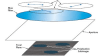
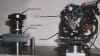
An analog electronic camera that is part of a metrology system measures the varying direction to a light-emitting diode that serves as a bright point target. In the original application for which the camera was developed, the metrological system is used to determine the varying relative positions of radiating elements of an airborne synthetic-aperture-radar (SAR) antenna as the airplane flexes during flight; precise knowledge of the relative positions as a function of time is needed for processing SAR readings.

The camera is based on a position-sensitive detector (PSD), which is a rectangular photodiode with output contacts at opposite ends. PSDs are usually used in triangulation for measuring small distances. PSDs are manufactured in both one- and two-dimensional versions.
Because it is very difficult to calibrate two-dimensional PSDs accurately, the focal-plane sensors used in this camera are two orthogonally mounted one-dimensional PSDs. The camera also includes a beam splitter and two cylindrical lenses to focus line images of the target onto the PSDs — more specifically, to form a horizontal line image on the vertically oriented PSD and a vertical line image on the horizontally oriented PSD. The outputs from both ends of each PSD are processed by analog circuitry (see figure) to obtain an analog signal proportional to the displacement of the image centroid from the midlength position along the PSD. The direction-measuring error of the readout has been found to be no more than 1/2,700 of the angular width of the field of view.
This work was done by Carl Liebe, Randall Bartman, Jacob Chapsky, Alexander Abramovici, and David Brown of Caltech for NASA’s Jet Propulsion Laboratory. NPO-41466
This Brief includes a Technical Support Package (TSP).
Target-Tracking Camera for a Metrology System
(reference NPO-41466) is currently available for download from the TSP library.
Don't have an account?
Overview
The document presents a Technical Support Package for the Target-Tracking Camera for a Metrology System, identified as NPO-41466, developed by NASA's Jet Propulsion Laboratory (JPL). This innovation addresses a critical problem encountered during the GEOSAR mission, where an aircraft equipped with radar antennas required precise knowledge of the relative positions of its radiating elements to facilitate synthetic aperture radar (SAR) processing. The challenge arose from the deformation of the aircraft's wings during flight, which complicated SAR processing without accurate data on fuselage and wing deformation.
The solution proposed in this document involves the use of a position-sensitive detector (PSD), specifically a rectangular photodiode with readouts at both ends. The invention employs two orthogonally mounted one-dimensional PSDs as focal plane elements, overcoming the calibration difficulties associated with two-dimensional PSDs. The camera utilizes standard optics with a beam splitter, achieving remarkable accuracy of 1/2700 of the field of view.
A significant aspect of this invention is its ability to determine the bearing of bright target point sources without the need for a computer to calculate centroids, which is a common requirement in traditional metrology systems that utilize CCD cameras. By leveraging the brightness of the targets, the analog camera can achieve an unprecedented update frequency of hundreds of hertz, significantly surpassing the tens of hertz limit typical of digital systems.
The document emphasizes the novelty of this technology, highlighting its potential applications in various fields beyond aerospace, given its efficiency and accuracy. It is part of NASA's Commercial Technology Program, aimed at disseminating aerospace-related developments with broader technological, scientific, or commercial implications.
For further inquiries or assistance, the document provides contact information for the Innovative Technology Assets Management at JPL, encouraging collaboration and exploration of this innovative technology. Overall, the Target-Tracking Camera represents a significant advancement in metrology systems, promising enhanced performance in radar processing and potentially transforming applications across multiple domains.