

Two apparatuses now under development are intended to perform a variety of deep-drilling, coring, and sensing functions for subsurface exploration of rock and soil. These are modified versions of the apparatuses described in "Ultrasonic/Sonic Drill/Corers With Integrated Sensors" (NPO-20856), NASA Tech Briefs, Vol. 25, No. 1 (January 2001), page 38. In comparison with the drilling equipment traditionally used in such exploration, these apparatuses weigh less and consume less power. Moreover, unlike traditional drills and corers, these apparatuses function without need for large externally applied axial forces.
To recapitulate from the cited prior article: An apparatus of this type is an approximately cylindrically shaped vehicle that contains driving and controlling electronic circuits plus sensors and associated electronic circuitry. The vehicle also contains an electronically driven piezoelectric actuator that excites a combination of ultrasonic and sonic vibrations that give rise to hammering action at a tip that, as a result of this action, advances through the soil, rock, or other material in which it is embedded. The combination of ultrasonic and sonic vibrations is more effective for drilling than is the microhammering action of ultrasonic vibrations alone. Unlike in conventional twist drilling, a negligible amount of externally applied axial force is needed to make the apparatus advance through the material. Because there are transverse vibrations as well as longitudinal ones, a hole somewhat wider than the apparatus is formed; consequently, unlike in the case of a conventional twist drill, there is resistance to jamming and tolerance of misalignment.
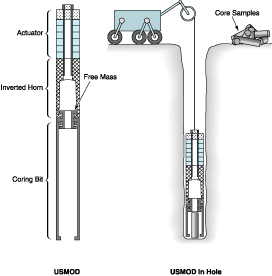
Each of the present developmental apparatuses is denoted an ultrasonic/sonic mechanism of deep drilling (USMOD). In each USMOD, a hollow cylindrical piezoelectric actuator vibrates an inverted horn that impinges on a bobbin-shaped free mass. In addition to serving as a linkage between the horn and a drilling or coring bit, the free mass also functions as a frequency transformer, producing the low-frequency hammering action. The drilling or coring bit has an outside diameter about equal to or greater than that of the actuator. Tangential forces generated by actuation of the drilling or coring bit are expected not only to prevent jamming but also to be exploitable for simple steering. The cavity inside the actuator and horn sections contains packages of electronic circuitry and possibly some or all sensors.
Both USMODs are designed to drill to depths much greater than their lengths. One USMOD (see Figure 1) is intended for use mainly in acquiring cores. It is denoted an ultrasonic gopher because, like a gopher, it periodically stops advancing at the end of the hole to bring excavated material (in this case, a core sample) to the surface, then re-enters the hole to resume the advance of the end of the hole. By use of a cable suspended from a reel on the surface, this USMOD is lifted from the hole to remove a core sample, then lowered into the hole to resume the advance and acquire the next core sample.
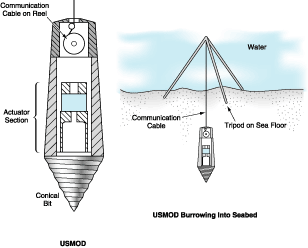
The other USMOD (see Figure 2) is intended to perform sensing at a desired depth. Instead of a cylindrical coring bit, this USMOD is equipped with a conical drilling bit. This USMOD is denoted an ultrasonic crab because, like a sand crab, it burrows by rapidly shaking its body. Unlike the ultrasonic gopher, this one does not acquire samples or leave an open hole behind itself: instead, debris from drilling are pushed behind this USMOD as it advances, closing the hole behind it. A wire for communication with a surface unit is unwound from a reel in a rear compartment as this USMOD advances through the ground.
This work was done by Yoseph Bar-Cohen, Stewart Sherrit, and Benjamin Dolgin of Caltech and Steve Askin, Thomas M. Peterson, Bill Bell, Jason Kroh, Dharmendra Pal, Ron Krahe, and Shu Du of Cybersonics for NASA's Jet Propulsion Laboratory. For further information, access the Technical Support Package (TSP) free on-line at www.techbriefs.com /strong> under the Machinery/ Automation category.
NPO-30291











