


A system for automated sampling of rocks, ice, and similar hard materials at and immediately below the surface of the ground is undergoing development. The system, denoted a sample preparation, acquisition, handling, and delivery (SPAHD) device, would be mounted on a robotic exploratory vehicle that would traverse the terrain of interest on the Earth or on a remote planet. The SPAHD device would probe the ground to obtain data for optimization of sampling, prepare the surface, acquire samples in the form(s) of cores and/or powdered cuttings, and deliver the samples to a selected location for analysis and/or storage.
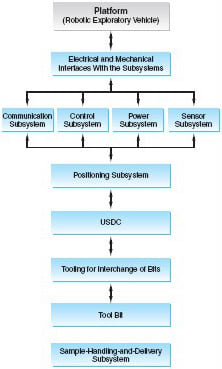
The SPAHD device would be built around an ultrasonic/sonic drill corer (USDC) — an apparatus that was reported in “Ultrasonic/Sonic Drill/ Corers With Integrated Sensors” (NPO-20856), NASA Tech Briefs, Vol. 25, No. 1 (January 2001), page 38. To recapitulate: A USDC includes a hollow drill bit or corer, in which combinations of ultrasonic and sonic vibrations are excited by an electronically driven piezoelectric actuator. The corer can be instrumented with a variety of sensors (and/or the drill bit or corer can be used as an acoustic impedance sensor) for both probing the drilled material and acquiring feedback for control of the excitation. The USDC advances into the material of interest by means of a hammering action and a resulting chiseling action at the tip of the corer. The hammering and chiseling actions are so effective that unlike in conventional twist drilling, a negligible amount of axial force is needed to make the USDC advance into the material. Also unlike a conventional twist drill, the USDC operates without need for torsional restraint, lubricant, or a sharp bit.
In addition to a USDC, the SPAHD device (see Figure 1) would include sensor, control, and communication subsystems; a subsystem for positioning the USDC at the desired position and orientation on the ground; a set of interchangeable USDC bits; a tool rack to store the bits; and mechanisms for manipulating and delivering samples. The bits would be attached to, and detached from, a resonator horn of the piezoelectric actuator by means of simple-to-operate snap-on/snap-off mechanisms. The set of bits would include a probing bit, bits for cutting cores and collecting powdered cuttings, bits for extracting the cores after they have been cut (see Figure 2), and an ultrasonic rock abrasion tool (URAT) bit [described in “Ultrasonically Actuated Tools for Abrading Rock Surfaces” (NPO-30403), NASA Tech Briefs, Vol. 30, No. 7 (July, 2006), page 58.
This work was done by Yoseph Bar-Cohen, James Randolph, Xiaoqi Bao, Stewart Sherrit, Chuck Ritz, and Greg Cook of Caltech for NASA’s Jet Propulsion Laboratory. For further information, access the Technical Support Package (TSP) free online at www.techbriefs.com/tsp under the Machinery/Automation category. NPO-30640
This Brief includes a Technical Support Package (TSP).
System Would Acquire Core and Powder Samples of Rocks
(reference NPO-30640) is currently available for download from the TSP library.
Don't have an account?
Overview
The document is a Technical Support Package from NASA, specifically referencing NPO-30640, which outlines an innovative system designed for the acquisition of core and powdered samples of rocks. This system is integral for performing multiple functions, including media probing, screening, surface preparation, extraction of samples, and the manipulation and delivery of these samples.
The report highlights the advantages of this system over conventional methods such as traditional drills, scooping devices, and complex robotic systems. While these conventional methods have been used for geological sampling, the new system offers a more integrated approach that enhances efficiency and effectiveness in sample acquisition and handling.
The document emphasizes the importance of this technology within the context of aerospace-related developments, suggesting that the innovations have broader technological, scientific, and commercial applications beyond their initial purpose. It is part of NASA's efforts to disseminate information about advancements that could benefit various industries and research fields.
Additionally, the report provides contact information for further assistance and resources available through the NASA Scientific and Technical Information (STI) Program Office. This includes a website link and contact details for inquiries, indicating NASA's commitment to sharing knowledge and fostering partnerships in innovative technology.
Overall, the document serves as a comprehensive overview of a significant technological advancement in the field of geological sampling, showcasing NASA's role in pioneering research and development that can have far-reaching implications in both scientific exploration and commercial applications.










