

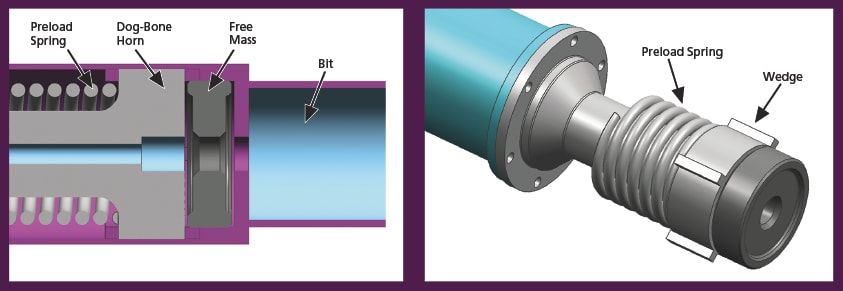
A piezoelectrically actuated percussive bit augments rotary drills to form a rotary-hammering drill/sampler. The Percussive Augmenter of Rotary Drills (PARoD) bit has two key modalities: one with vibrating free-mass and one without. In the first modality, the bit is designed to rotate the tip and transmit the impact of a free mass, while the complete bit turns as a single unit. In the second modality, the ultrasonic hammering action from the piezoelectric stack and the rotation from a commercial drill are applied directly to the drilled object. The PARoD tool includes slots to ensure that the tip of the bit does not rotate separately from the piezoelectric actuator. The bit employs electric and mechanical slip rings to transfer electric power, as well as water (for removal of cuttings and bit cooling), while freely turning the bit. The cooling plumbing can be connected to the related fixtures on heavy-duty commercial rotary drills.
This work was done by Jack B. Aldrich, Yoseph Bar-Cohen, Stewart Sherrit, Mircea Badescu, Xiaoqi Bao, and James S. Scott of Caltech for NASA’s Jet Propulsion Laboratory.
In accordance with Public Law 96-517, the contractor has elected to retain title to this invention. Inquiries concerning rights for its commercial use should be addressed to:
Innovative Technology Assets Management
JPL
Mail Stop 202-233
4800 Oak Grove Drive
Pasadena, CA 91109-8099
E-mail: This email address is being protected from spambots. You need JavaScript enabled to view it.
Refer to NPO-46550.
This Brief includes a Technical Support Package (TSP).
Percussive Augmenter of Rotary Drills for Operation as a Rotary-Hammer Drill
(reference NPO-46550) is currently available for download from the TSP library.
Don't have an account?
Overview
The document outlines NASA's development of the Percussive Augmenter of Rotary Drills (PARoD), a technology designed to enhance the performance of commercial rotary drills by integrating a percussive bit. This innovation aims to address the challenges faced in drilling operations, particularly for future NASA missions that require effective sample collection and analysis, such as the Mars Sample Return mission.
The PARoD tool is engineered to augment the capabilities of existing rotary drills, significantly increasing drilling speed—by a factor of ten, as demonstrated in prior designs. The tool operates using a piezoelectric actuator, which drives the percussive bit, allowing it to fracture rock or concrete through induced stress pulses. The design includes two modalities: one without a free-mass, where the ultrasonic hammering action is applied directly to the drilled object, and another with a free-mass, which allows for the transmission of impacts while the bit rotates as a single unit.
The document details the technical aspects of the PARoD, including its size, which is comparable to the Ultrasonic/Sonic Gopher developed for Antarctic drilling, and its capability to operate with various diameters. The bit is designed to utilize the power and cooling systems of commercial rotary drills, making it adaptable and efficient.
Additionally, the document discusses the use of electric slip-rings to supply high-frequency power to the piezoelectric actuator, highlighting considerations such as cost, maximum operation speed, and dimensions. The integration of water delivery systems for cooling and cuttings removal is also addressed, showcasing the tool's comprehensive design for effective drilling operations.
Overall, the PARoD represents a significant advancement in drilling technology, with potential applications in in-situ exploration missions that require precise sample collection and analysis. The research was conducted at NASA's Jet Propulsion Laboratory, emphasizing the agency's commitment to developing innovative solutions for future space exploration challenges. The document serves as a technical support package, providing insights into the research and technology transfer opportunities associated with this development.











