An easy-to-implement design concept shows promise for improving the performances of impact tool bits used in abrading surfaces, drilling, and coring of rock and rocklike materials. The concept is especially applicable to tools actuated with a combination of ultrasonic and sonic vibrations, as in the cases described in “Ultrasonic/Sonic Drill/Corers With Integrated Sensors (NPO- 20856), NASA Tech Briefs, Vol. 25, No. 1 (January 2001), page 38. Such tools were originally intended to be used in scientific drilling and coring of rock; they might also be useful for drilling, coring, and surface grinding of rock for art and construction.
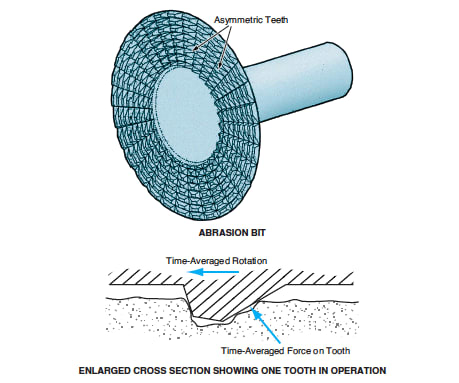
The present design concept is simply to make the teeth asymmetric, so that the hammering action of the tool against the rock face gives rise to a net torque that causes the tool to rotate, even in the absence of a rotary actuator (see figure). The rotation prevents the formation of a footprint, thereby helping to ensure that contact between the tool and the rock takes place predominantly at the tooth tips, with consequent concentration of impact forces at tooth tips and, hence, higher impact stresses resulting in a greater rate of removal of rock.
This work was done by Benjamin Dolgin, Stewart Sherrit, Yoseph Bar-Cohen, Stephen Askins, Deborah Sigel, Xiaoqi Bao, and Zensheu Chang of Caltech for NASA’s Jet Propulsion Laboratory.
This Brief includes a Technical Support Package (TSP).
Ultrasonic/Sonic Vibrating/Rotating Tool Bits.
(reference NPO-30370) is currently available for download from the TSP library.
Don't have an account?
Overview
The document is a NASA Technical Support Package detailing an innovative approach to drilling technology, specifically focusing on Ultrasonic/Sonic Vibrating/Rotating Tool Bits. The invention, credited to a team of researchers including Benjamin Dolgin, Stewart Sherrit, and others, presents a novel mechanism for enhancing the efficiency of impact drill bits used in various applications, particularly in space exploration.
The primary novelty of this invention lies in its design of impact drill bits that incorporate a unique rotation mechanism. Unlike traditional rotary actuators, this design utilizes modifications to the drill bit itself to induce rotation. This is achieved through the incorporation of asymmetric teeth on the bit's surface, which, when they impact the rock, create reaction forces that facilitate rotation. This innovative approach not only prevents the drill bit from locking in place, a common issue that reduces drilling rates, but also significantly improves drilling efficiency.
The document outlines the specific problems the invention aims to solve, particularly the inefficiencies associated with conventional impact drills that require high axial loads and can introduce contamination from lubricants and mechanical components. The Ultrasonic/Sonic Drill and Corer (USDC) offers a solution by requiring lower axial forces and fewer components, making it suitable for in-situ sampling and analysis in future NASA missions.
The technical disclosure emphasizes the advantages of the USDC, including its ability to operate effectively with low average power while producing cores and powder cuttings. The performance of the drill bits is enhanced when they are allowed to move along the rock surface, which can nearly double their effectiveness.
In summary, the document presents a significant advancement in drilling technology through the development of ultrasonic/sonic vibrating/rotating tool bits. By leveraging innovative bit designs and mechanisms that convert vibrations into rotational motion, this invention promises to improve drilling rates and efficiency, making it a valuable asset for future exploration missions, particularly in challenging environments like those encountered in space. The research was conducted at the Jet Propulsion Laboratory under NASA's sponsorship, highlighting its relevance to cutting-edge aerospace applications.