

Inside this issue
Supplements
Overview
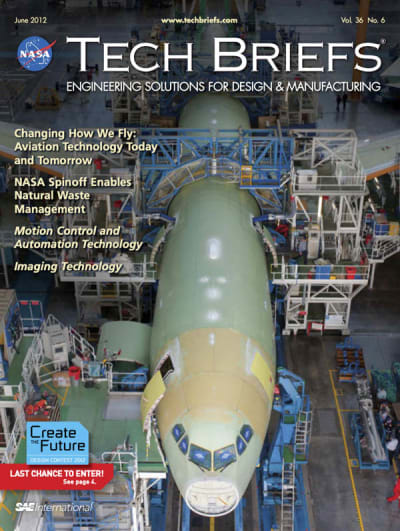
The June 2012 edition of NASA Tech Briefs presents a comprehensive overview of advancements in technology, particularly focusing on imaging technology, motion control, and automation. This issue highlights the intersection of innovation and practical applications, showcasing how NASA's research and developments are influencing various industries.
Key Features and Highlights
-
Changing How We Fly: Aviation Technology Today and Tomorrow The magazine opens with a feature on the evolution of aviation technology, emphasizing how NASA's research is paving the way for future advancements in flight. This section discusses the integration of new materials, designs, and technologies that enhance safety, efficiency, and environmental sustainability in aviation.
-
NASA Spinoff Enables Natural Waste Management A significant highlight of this issue is the exploration of NASA spinoff technologies that contribute to natural waste management. The article details how innovations developed for space missions are being adapted for use on Earth, particularly in waste treatment and management systems. This not only showcases the versatility of NASA's research but also its impact on environmental sustainability.
-
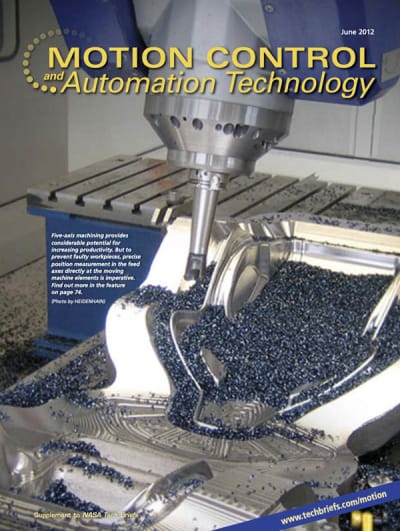
Motion Control and Automation Technology The issue delves into the realm of motion control and automation, emphasizing the importance of precision in manufacturing processes. A feature discusses five-axis machining, which offers considerable potential for increasing productivity in manufacturing. The article stresses the necessity of precise position measurement in the feed axes to prevent faulty workpieces, highlighting advancements in sensor technology and control systems.
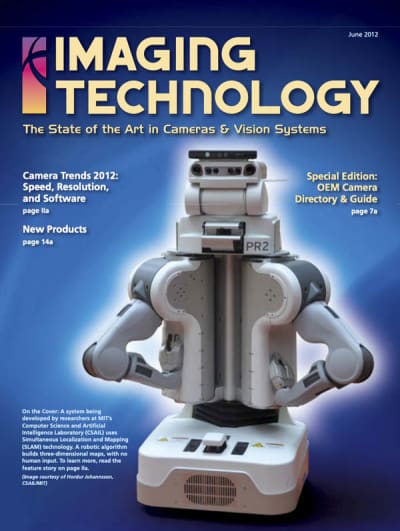
Camera Trends 2012: Speed, Resolution, and Software Another significant section focuses on the latest trends in camera technology. It discusses the increasing demands for higher speed, resolution, and advanced software capabilities in imaging systems. The article reviews various new products and innovations that cater to these demands, providing insights into how these technologies are being utilized across different sectors, including industrial automation and scientific research.
-
Special Edition: OEM Camera Directory & Guide This issue includes a special directory and guide for OEM cameras, offering readers a comprehensive resource for understanding the latest offerings in the camera market. This guide is particularly useful for engineers and developers looking to integrate advanced imaging solutions into their projects.
-
Innovative Research and Development The magazine features a spotlight on innovative research being conducted at institutions like MIT. One notable project involves the development of a robotic algorithm that utilizes Simultaneous Localization and Mapping (SLAM) technology. This system can build three-dimensional maps autonomously, showcasing the potential for robotics in various applications, from autonomous vehicles to advanced manufacturing.
-
New Products and Technologies The issue also highlights a range of new products that have recently entered the market. These innovations span various fields, including automation, imaging, and control systems, providing readers with insights into the latest tools and technologies available to enhance productivity and efficiency in their respective industries.
Conclusion
The June 2012 edition of NASA Tech Briefs serves as a vital resource for professionals and enthusiasts in the fields of technology and engineering. By showcasing the latest advancements in aviation, motion control, imaging technology, and environmental sustainability, this issue underscores the significant impact of NASA's research on both current and future technologies. The integration of space-derived innovations into everyday applications exemplifies the ongoing relevance of NASA's work and its potential to address pressing challenges on Earth.
Overall, this edition not only informs readers about the latest trends and technologies but also inspires them to consider the broader implications of these advancements in their own fields. Whether through improved waste management systems, enhanced manufacturing processes, or cutting-edge imaging technologies, the contributions of NASA and its partners continue to shape the future of technology and innovation.
Features
-
Application Briefs
NASA Adopts Modeling and Simulation Software for Space Exploration Projects
Thin-Film Tape Protects Mars Rover Wiring
Rendering Software Helps NASA’s Conceptual Image Lab Bring Science to the Public
Tech Briefs
-
Bio-Medical
Hardy Bacterium Isolated From Two Geographically Distinct Spacecraft Assembly Cleanroom Facilities
Loading, Release, Biodegradation, and Biocompatibility of a Nanovector Delivery System
-
Physical Sciences
Broad-Bandwidth FPGA-Based Digital Polyphase Spectrometer
Integrated Laser Characterization, Data Acquisition, and Command and Control Test System
Dual Double-Wedge Pseudo-Depolarizer With Anamorphic PSF
Sample-Clock Phase-Control Feedback
A Compact, High-Flux Cold Atom Beam Source
Microgravity Passive Phase Separator
Cavitating Jet Method and System for Oxygenation of Liquids
360° Camera Head for Unmanned Sea Surface Vehicles
In Situ Potassium-Argon Geochronology Using Fluxed Fusion and a Double Spike
Fiber-Optic Micrometeoroid/Orbital Debris Impact Detector System
-
Manufacturing & Prototyping
Single-Layer, All-Metal Patch Antenna Element With Wide Bandwidth
Scanning Laser Infrared Molecular Spectrometer (SLIMS)
Next-Generation Microshutter Arrays for Large-Format Imaging and Spectroscopy
-
Software
iGlobe Interactive Visualization and Analysis of Spatial Data
Small Aircraft Data Distribution System
Earth Science Datacasting v2.0
Security Data Warehouse Application
Active Mirror Predictive and Requirements Verification Software (AMP-ReVS)
Personal Computer Transport Analysis Program
Navigation/Prop Software Suite
Pressure Ratio to Thermal Environments
Probabilistic Fatigue Damage Program (FATIG)
JPL Genesis and Rapid Intensification Processes (GRIP) Portal
Fault Tolerance Middleware for a Multi-Core System
DspaceOgreTerrain 3D Terrain Visualization Tool
Trick Simulation Environment 07
-
Materials
Enhanced-Adhesion Multiwalled Carbon Nanotubes on Titanium Substrates for Stray Light Control
Ultra-Lightweight Nanocomposite Foams and Sandwich Structures for Space Structure Applications
-
Information Sciences
Algorithm for Compressing Time-Series Data
Onboard Science and Applications Algorithm for Hyperspectral Data Reduction
Sampling Technique for Robust Odorant Detection Based on MIT RealNose Data
Rapid Process to Generate Beam Envelopes for Optical System Analysis
High-Performance, Multi-Node File Copies and Checksums for Clustered File Systems
Space Operations Learning Center Facebook Application
Sampling and Reconstruction of the Pupil and Electric Field for Phase Retrieval
Recursive Branching Simulated Annealing Algorithm
Method for Pre-Conditioning a Measured Surface Height Map for Model Validation
-
Semiconductors & ICs
Thermally Resilient, Broadband Optical Absorber From UV to IR Derived From Carbon Nanostructures
Verilog-A Device Models for Cryogenic Temperature Operation of Bulk Silicon CMOS Devices
-
Electronics & Computers
High-Voltage, Low-Power BNC Feedthrough Terminator
Dichroic Filter for Separating W-Band and Ka-Band
Hardware Implementation of Lossless Adaptive Compression of Data From a Hyperspectral Imager
Radiation-Hard SpaceWire/Gigabit Ethernet-Compatible Transponder











