With present concern for ecological sustainability ever increasing, it is desirable to model the composition of Earth’s upper atmosphere accurately with regards to certain helpful and harmful chemicals, such as greenhouse gases and ozone. The microwave limb sounder (MLS) is an instrument designed to map the global day-to-day concentrations of key atmospheric constituents continuously. One important component in MLS is the spectrometer, which processes the raw data provided by the receivers into frequency-domain information that cannot only be transmitted more efficiently, but also processed directly once received. The present-generation spectrometer is fully analog. The goal is to include a fully digital spectrometer in the next-generation sensor. In a digital spectrometer, incoming analog data must be converted into a digital format, processed through a Fourier transform, and finally accumulated to reduce the impact of input noise. While the final design will be placed on an application specific integrated circuit (ASIC), the building of these chips is prohibitively expensive. To that end, this design was constructed on a field-programmable gate array (FPGA).
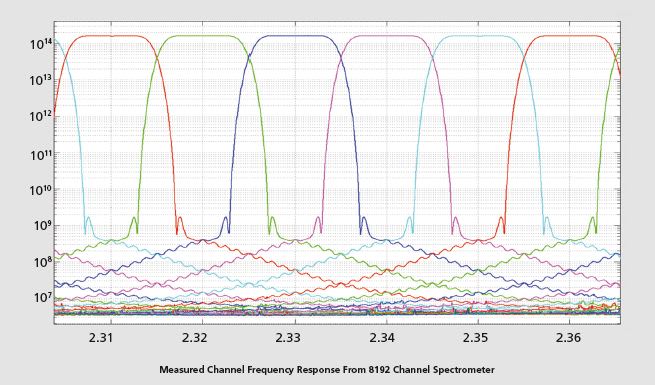
The high-level building blocks (filter and FFT components) were optimized for the Xilinx Virtex 5 FPGA, and for interfacing with one another. The design, from building blocks to complete implementation, was floor-planned in order to make efficient use of the FPGA resources. As more aggressive spectrometer designs were created, designing the hardware to run at a sufficiently high clock rate became progressively more difficult. These issues were mitigated by duplicating hardware and adding (or removing) latency as necessary. The floor-planning of the design was changed dramatically from the original.
The final spectrometer design is an 8192-channel implementation. Designed with additional output capacity, the spectrometer has superior frequency resolution, dynamic range, and accumulation length when compared to previous versions. An alternate, dual-polarization, 1.5-GHz, 4096-channel spectrometer is available as well. Both designs are capable of accumulating for hours, several orders of magnitude over what is required.
In addition, a further improved spectrometer with double the frequency resolution, a polyphase-FIR filter front end, and substantially reduced noise has been successfully simulated and is presently in the final stages of development. When finished, it will offer a spectrometer developed on Virtex-5 hardware with bandwidth and spectral resolution an order of magnitude greater than the analog spectrometers presently in use.
Plans to make an 8-GHz spectrometer taking advantage of the same technology used for this device are already being made. Finally, efforts are presently being made to interface this design to a compact Nallatech board, which consumes less power and can be more readily used in remote locations and demanding environments.
This work was done by Robert F. Jarnot of Caltech and Ryan M. Monroe of Georgia Tech for NASA’s Jet Propulsion Laboratory. NPO-48352
This Brief includes a Technical Support Package (TSP).
Broad-Bandwidth FPGA-Based Digital Polyphase Spectrometer
(reference NPO-48352) is currently available for download from the TSP library.
Don't have an account?
Overview
The document is a report on a NASA internship project focused on developing a Broad-Bandwidth FPGA-Based Digital Polyphase Spectrometer. The primary goal of the project was to create a high-resolution spectrometer with excellent channel orthogonality, which is crucial for accurately analyzing incoming signals. Given the limitations of the FPGA chip's resources, the project emphasized optimizing algorithms to streamline the design while maintaining performance.
The report outlines the process of converting incoming analog data into a digital format, which involves several key steps: processing through a tapped finite impulse response (FIR) filter, performing a streaming Fourier Transform, and accumulating data to reduce the data rate and mitigate input noise. The final design is intended for implementation on an Application Specific Integrated Circuit (ASIC), but due to the high costs associated with ASIC manufacturing, the design is first prototyped on an FPGA. This approach allows for extensive testing and refinement before committing to the more expensive fabrication process.
As the project progressed, the complexity of the spectrometer designs increased, leading to challenges in achieving a sufficiently high clock rate for the hardware. To address these challenges, the design was modified by duplicating hardware components and adjusting latency as needed. The report also discusses significant changes made to the floorplan of the design, which were necessary to accommodate the larger and more complex designs.
The document includes an example of the spectrometer's output, showcasing actual atmospheric data captured at 230 GHz, highlighting the presence of an ozone line and interference from a television station. This demonstrates the spectrometer's capability to detect and analyze specific atmospheric components.
Additionally, the report mentions the creation of a personal library based on the xBlocks scripting language, which may serve as a resource for further development and experimentation in the field.
Overall, the report emphasizes the importance of optimizing hardware and algorithms in the development of advanced spectrometers, which have significant applications in aerospace and other scientific fields. The project reflects NASA's commitment to innovation and the practical application of technology in understanding and monitoring atmospheric phenomena.