Miniature, feedback-stabilized sources of broad-band light are under development for use in the illumination and calibration of imaging spectrometers and other optoelectronic scientific instruments. These sources would be designed and fabricated by use of techniques developed for semiconductor integrated circuits and extended to microelectromechanical systems (MEMS). In the original intended application, a device of this type would supplant the onboard calibrator (OBC) in NASA's airborne visible/infrared imaging spectrometer (AVIRIS).
Conventional OBCs contain off-the-shelf light bulbs and discrete electronic and optical components. In contrast, the developmental light sources have the potential to be smaller, less massive, and less power-hungry by several orders of magnitude (see table). The developmental light sources would be microfabricated out of silicon in predominantly planar geometries like those of typical integrated circuits; consequently, it would be relatively easy to integrate the light sources with silicon-based electronic drive circuitry and with optical fibers. In comparison with conventional OBCs, the developmental light sources would be relatively insensitive to fluctuations in temperature. Moreover, because they would be less massive, they would operate with shorter stabilization times.
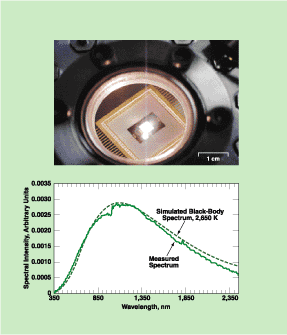
A device of the type under development would be a fully integrated, monolithic optoelectronic system that would include a micromachined incandescent lamp, a fiber-optic output coupler, and an infrared photodetector and associated electronic circuitry for negative-feedback stabilization of the current supplied to (and thus the brightness and temperature of) the lamp. Micromachined incandescent lamps like those that would be incorporated into these devices were described in "Micromachined Broad Band Light Sources" (NPO-20655),NASA Tech Briefs, Vol. 25, No. 4 (April 2001), page 44. A prototype that included only a lamp has been demonstrated (see figure). Integration of a lamp with a photodetector and feedback circuitry is a goal of proposed development efforts for the near future.
Key Parameters of current and developmental OBCs for the AVIRIS are compared. The values for the developmental OBC are estimates based partly on the anticipated integration of all optical and electronic components.
This work was done by Thomas George, Eric Jones, Michael Eastwood, Margaret Tuma, and Richard Hansler of Caltech forNASA's Jet Propulsion Laboratory.
In accordance with Public Law 96-517, the contractor has elected to retain title to this invention. Inquiries concerning rights for its commercial use should be addressed to
Intellectual Property group
JPL
Mail Stop 202-233
4800 Oak Grove Drive
Pasadena, CA 91109
(818) 354-2240
Refer to NPO-20935.
This Brief includes a Technical Support Package (TSP).
Miniature, Feedback-Stabilized, Broad-Band Light Sources
(reference NPO20935) is currently available for download from the TSP library.
Don't have an account?
Overview
The document discusses the development of miniature, feedback-stabilized, broad-band light sources intended for use in the illumination and calibration of imaging spectrometers and other optoelectronic scientific instruments. These innovative light sources are being designed and fabricated using techniques derived from semiconductor integrated circuits and microelectromechanical systems (MEMS). The primary application for these devices is to replace the conventional onboard calibrator (OBC) used in NASA’s Airborne Visible/Infrared Imaging Spectrometer (AVIRIS).
Traditional OBCs rely on off-the-shelf light bulbs and discrete electronic and optical components, which can be bulky and power-hungry. In contrast, the new developmental light sources promise significant advantages, including reduced size, weight, and power consumption—estimated to be several orders of magnitude lower than current OBCs. The developmental light sources are expected to be microfabricated from silicon in planar geometries similar to those used in typical integrated circuits, facilitating easy integration with silicon-based electronic drive circuitry and optical fibers.
The document highlights that these new light sources will be relatively insensitive to temperature fluctuations and will operate with shorter stabilization times due to their reduced mass. The fully integrated optoelectronic system will include a micromachined incandescent lamp, a fiber-optic output coupler, and an infrared photodetector, along with associated electronic circuitry for negative-feedback stabilization of the lamp's current, which controls its brightness and temperature.
A proof-of-principle demonstration of a micromachined incandescent lamp has already been conducted, showing that the emitted light spectrum approximates a black-body spectrum at a temperature of 2,650 K. The document also compares key parameters of current and developmental OBCs for the AVIRIS, indicating that the new design will have a volume of approximately 30 cm³ and a mass of about 50 g, compared to the current OBC's volume of 15,000 cm³ and mass of 2,000 g. Power consumption is projected to be around 2 W for the developmental OBC, significantly lower than the current 30 W.
The work was carried out by a team from Caltech for NASA’s Jet Propulsion Laboratory, and inquiries regarding commercial use of the invention are directed to the JPL Intellectual Property group.