

White Paper: Electronics & Computers
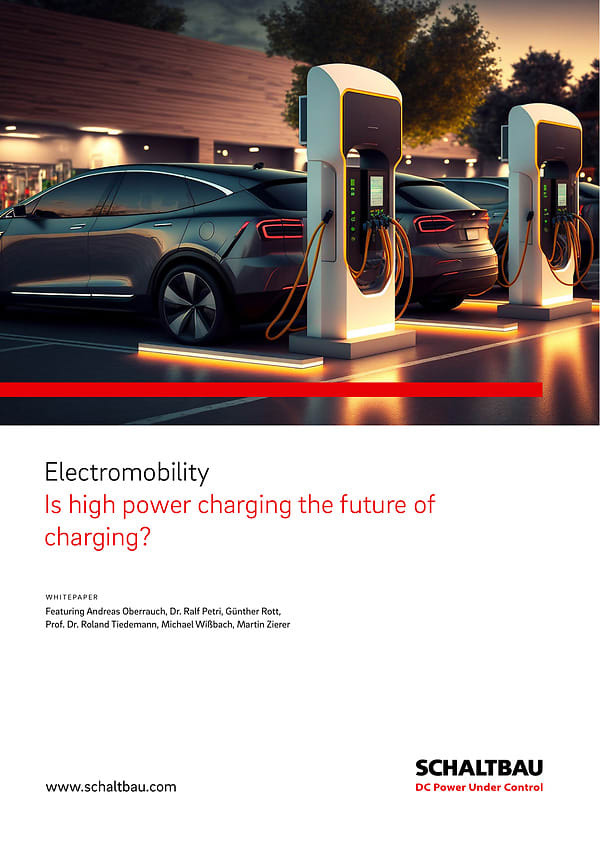
Electromobility | Is High Power Charging the Future of Charging?
SPONSORED BY: ![]()

Electric vehicles are driving the need for a scalable, future‑ready charging infrastructure. This white paper explores the evolution of high‑power charging, comparing AC and DC methods, outlining CCS requirements, and examining the rapid expansion of HPC stations. It highlights grid‑capacity challenges, the role of buffer storage, megawatt charging for commercial fleets, battery‑swap alternatives, and the rise of bidirectional charging. Readers gain clarity on HPC definitions, safety mechanisms, fast‑charging technology, and emerging trends shaping tomorrow’s EV ecosystem.
Don't have an account?
Overview
The white paper "Electromobility | Is high power charging the future of charging?" by Schaltbau GmbH explores the rapidly evolving landscape of electric vehicle (EV) charging infrastructure, emphasizing the critical role of high power charging (HPC) and emerging technologies.
As electric vehicle adoption accelerates globally—with projections of 350 million EVs by 2030—the demand for faster, more convenient charging solutions intensifies. Conventional AC charging, which typically offers up to 22 kW and relies on onboard vehicle converters, suffices for many daily users but falls short for longer trips or commercial logistics. To minimize charging time and increase user acceptance, HPC stations delivering 150 kW and above have expanded significantly, especially along major traffic routes. Germany exemplifies this growth, quadrupling fast charging points between 2017 and 2021, with half supporting HPC.
However, integrating HPC poses challenges for the existing electrical grid, including instability risks. Innovative approaches like buffer storage systems—batteries that absorb energy during low demand and release it during charging peaks—offer promising solutions to mitigate grid strain. Research into charging up to 400 kW via standard 230V connections shows potential for scalable high-capacity charging without overloading grids.
For commercial vehicles, even higher demands arise. Megawatt Charging Systems (MCS), developed by initiatives such as CharIN, enable charging at capacities of three megawatts or more, essential for heavy trucks and electric ships. Complementary technologies like overhead contact line systems allow trucks to draw power directly from infrastructure during travel, reducing reliance on charging stops.
Bidirectional charging further expands the EV ecosystem’s potential by enabling vehicles to serve as mobile energy storage, contributing to grid stability during peak periods or surplus renewable energy generation. Industry stakeholders, including Schaltbau, alpitronic, CuroCon, and VDE, are actively advancing standards, technologies, and infrastructure to accommodate these trends.
The paper also touches on battery exchange models, notably successful in China, which offer an alternative to fast charging by quickly swapping depleted batteries for charged ones, reducing downtime.
In sum, while AC charging remains vital, the future of electromobility hinges on scalable high power and megawatt charging solutions integrated with smart grid management and innovative energy storage, paving the way for widespread EV adoption across passenger and commercial sectors.