

White Paper: Communications
OSFP-XD vs. CDFP Cabling Solutions
SPONSORED BY: ![]()

Data centers are constantly evolving, and so are their high-performance computing needs. In this paper, we present two high-speed connector types or form factors that form part of the cabling ecosystem for server, storage, and networking, transmitting data with industry-leading efficiency and signal integrity. They are the OSFP-XD (Octal Small Form Factor Pluggable, eXtra Dense) and the CDFP. Both OSFP-XD and CDFP follow standardized designs, compliant with industry standard multi-source agreements, thereby ensuring vendor interoperability.
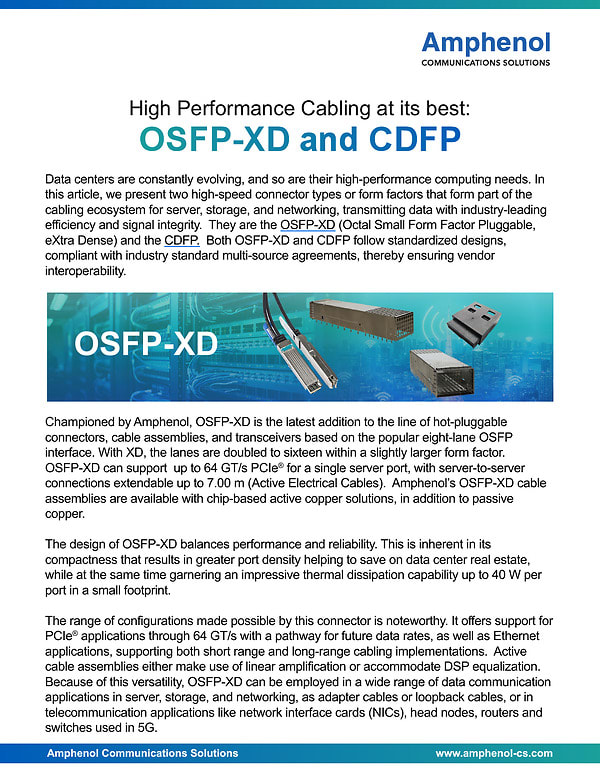
OSFP-XD is the latest addition to the line of hot-pluggable connectors, cable assemblies, and transceivers based on the popular eight-lane OSFP interface. With XD, the lanes are doubled to sixteen within a slightly larger form factor.
Amphenol’s CDFP copper cable assemblies target the PCI-SIG® CopprLinkTM specification. With a per lane data rate variants supporting 32 GT/s and 64 GT/s, CDFP leverages PCIe® full potential over 16 channels, to reach aggregate bandwidths of 512 Gb/s and 1024 Gb/s, respectively.
Don't have an account?
Overview
The document discusses two advanced high-speed connector types developed by Amphenol Communications Solutions: the OSFP-XD (Octal Small Form Factor Pluggable, eXtra Dense) and the CDFP (CD Form Factor Pluggable). Both connectors are integral to the cabling ecosystem for server, storage, and networking applications, ensuring efficient data transmission with high signal integrity and compliance with industry standards for vendor interoperability.
The OSFP-XD is a hot-pluggable connector that enhances the popular OSFP interface by doubling the lanes from eight to sixteen, allowing it to support data rates of up to 64 GT/s PCIe® for a single server port. It is designed for both short-range and long-range cabling implementations, with active electrical cables extending up to 7.00 meters. The OSFP-XD's compact design not only increases port density, saving valuable data center space, but also provides impressive thermal dissipation capabilities of up to 40 W per port. This versatility makes it suitable for a wide range of applications, including network interface cards (NICs), routers, switches, and telecommunication systems, particularly in 5G environments.
On the other hand, the CDFP connector is characterized by its initial aggregate data transfer capacity of 400 Gb/s, achieved through 16 channels. It supports PCIe® data rates of 32 GT/s and 64 GT/s, enabling aggregate bandwidths of 512 Gb/s and 1024 Gb/s, respectively. Unlike the OSFP-XD, the CDFP relies on a riding heat sink for thermal management, which limits its cooling capabilities but allows for lower power consumption and cost-effective port solutions. The CDFP is compliant with the SFF-TA-1032 industry standard and is positioned as a viable alternative to optical connections.
Both connectors are designed to meet the evolving needs of high-performance computing (HPC), which is increasingly decentralized and distributed. They cater to the demands of modern data centers, whether centralized or edge-based, and are optimized for various applications, including Ethernet and PCIe. The document emphasizes the importance of these connectors in enhancing data communication efficiency and supporting the future of high-speed networking.