

White Paper: Motion Control
How Drive Technology Brings Robotic Hands to Life
SPONSORED BY: ![]()

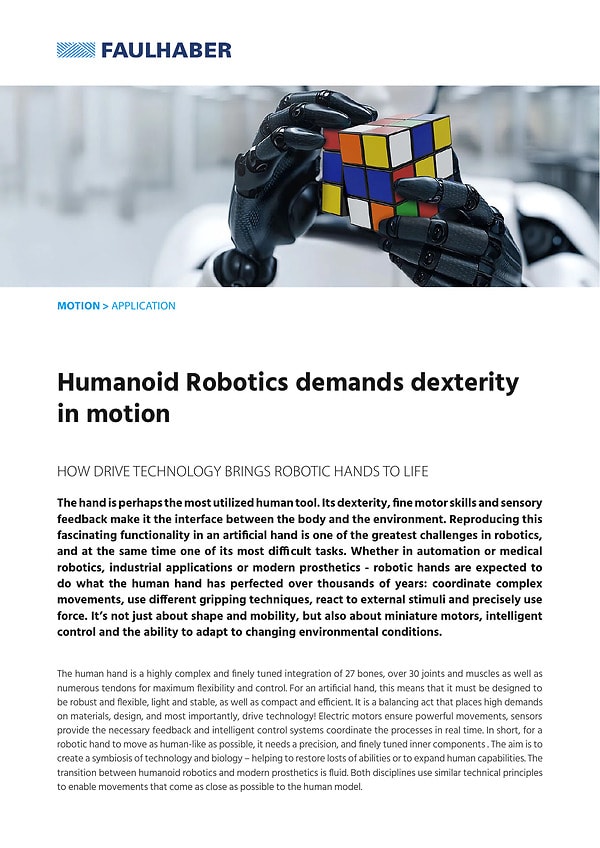
The hand is perhaps the most utilized human tool. Its dexterity, fine motor skills and sensory feedback make it the interface between the body and the environment. Reproducing this fascinating functionality in an artificial hand is one of the greatest challenges in robotics, and at the same time one of its most difficult tasks. This tutorial explains how drive technology helps with the symbiosis of technology and biology, allowing for the coordination of complex movements, the use of different gripping techniques, and the precise use of force.
Don't have an account?
Overview
The document discusses the intricate challenges and advancements in humanoid robotics, particularly focusing on the development of robotic and prosthetic hands that replicate the dexterity and functionality of human hands. It emphasizes that the human hand is a highly complex structure, consisting of 27 bones, over 30 joints, and numerous tendons, which allows for fine motor skills and sensory feedback. The goal of creating artificial hands is to achieve a similar level of coordination, adaptability, and precision.
Key to this endeavor is the drive technology that powers these robotic hands. Each finger of a robotic hand is typically driven by one or more actuators, with more than 20 drives often used per hand to facilitate complex motion sequences. The document highlights the importance of miniaturization, precision, dynamics, and energy efficiency in the design of these drive systems. Compact and efficient components are essential for enabling a range of gripping techniques, from delicate movements to powerful grips.
FAULHABER, a company with decades of experience in high-precision drive systems, is mentioned as a key player in this field. Their DC motors, particularly from the SXR family, are noted for their innovative design and suitability for use in artificial hands. These motors, combined with high-precision planetary gearheads, provide the necessary performance for achieving natural and dynamic movements in confined spaces.
The document also touches on the broader applications of robotic hands, which span across medical robotics, industrial automation, and modern prosthetics. It underscores the importance of intelligent control systems and sensors that provide real-time feedback, allowing robotic hands to react to external stimuli and adapt to changing conditions.
Ultimately, the document conveys that the integration of advanced technology in robotic hands aims to create a symbiosis between technology and biology. This not only helps restore lost abilities for individuals with prosthetics but also expands human capabilities in various applications. The transition between humanoid robotics and prosthetics is fluid, with both fields utilizing similar technical principles to achieve human-like movements.