

White Paper: Medical
How to Install a Coiled Spring Pin
SPONSORED BY: ![]()

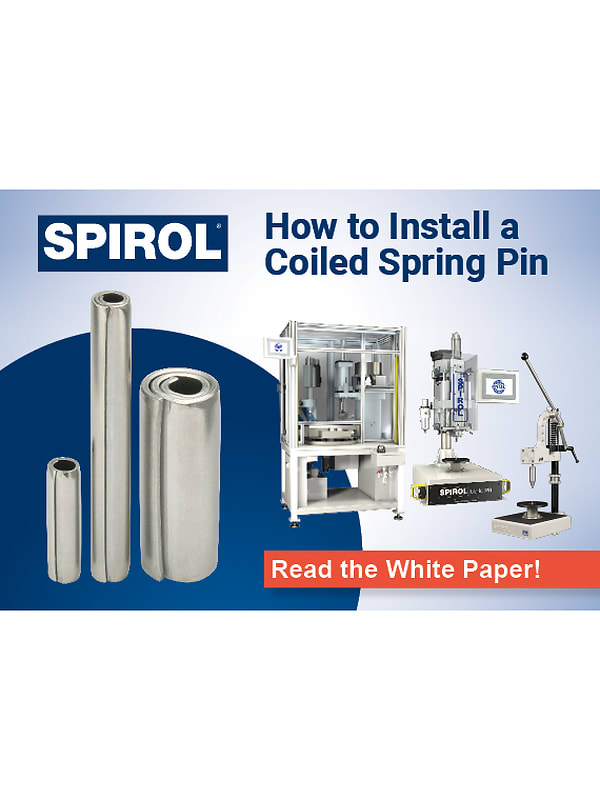
SPIROL’s Coiled Spring Pins are engineered for efficient assembly offering easy installation and reliable performance at the lowest total installed cost. Their 2 ¼ coil design and availability in light, standard, and heavy-duty options give designers the ability to optimize strength and flexibility to maximize assembly life. This White Paper presents a range of installation methods—from basic hammers to fully automatic equipment—to help manufacturers improve consistency, reduce cycle times, and lower costs.
Don't have an account?
Overview
The document provides a comprehensive overview of Coiled Pins, focusing on their design, installation methods, and advantages in assembly processes. Coiled Pins are engineered for easy installation, featuring square ends and concentric chamfers that reduce insertion forces and accommodate wider hole tolerances. This design allows them to compress during installation, conforming to the shape of the hole, making them the easiest type of pin to install.
The document outlines various installation methods for Coiled Pins, catering to different production needs. For low-volume or prototype assemblies, using a hammer is the simplest method. The process involves aligning the Coiled Pin with the hole and hammering it in, although this method is not recommended for small diameter pins due to handling difficulties.
For more controlled installations, a manual press or air hammer with a pin driving chuck is suggested. This method allows for better axial alignment and insertion depth control, making it suitable for small to medium production volumes. The pin driving chuck securely holds the pin in place during installation, enhancing efficiency.
For high-volume production, automatic pin inserters are preferred. These machines streamline the installation process by automatically feeding and inserting pins without requiring operator handling. The inserters can be customized with various features, such as adjustable workstations and monitoring systems, to meet specific manufacturing needs. The use of spring-loaded alignment pins is recommended for assemblies with through-holes to maintain proper alignment during installation.
Effective fixturing is emphasized as a critical element in the installation process, improving cycle times and reducing the risk of scrapped assemblies. The document also highlights the importance of proper alignment and insertion depth, which can be achieved through various installation methods.
Overall, the document serves as a guide for manufacturers looking to optimize their assembly processes with Coiled Pins, detailing the advantages of different installation techniques and the importance of alignment and fixturing in achieving high-quality results. It positions Coiled Pins as a versatile and efficient solution for various assembly applications, ultimately contributing to lower assembly costs and improved product quality.