
The Korea Institute of Energy Research (KIER) has successfully developed ultra-lightweight flexible perovskite/ CIGS (copper indium gallium selenide) tandem solar cells and achieved a power conversion efficiency of 23.64 percent, which is the world’s highest efficiency for flexible perovskite/CIGS tandem solar cells reported to date. The solar cells developed by the research team are extremely lightweight and can be attached to curved surfaces, making it a promising candidate for future applications in buildings, vehicles, aircraft, and more.
Crystalline silicon-based single-junction solar cells are predominantly used in solar power generation due to their low production cost and suitability for mass manufacturing. However, as the efficiency of single-junction solar cells approaches the theoretical limit, tandem solar cells — which combine silicon with perovskite solar cells to enhance efficiency — are gaining increasing attention.
Currently, perovskite/silicon tandem solar cells have achieved efficiencies as high as 34.6 percent. However, their heavy weight and susceptibility to physical damage limit their application in fields where lightness and adaptability are critical, such as in automobiles, aircraft, and satellites.
To overcome these limitations, flexible thin-film perovskite/CIGS tandem solar cells are being developed. CIGS-based thin-film solar cells are extremely lightweight and flexible, making them well-suited for use on curved surfaces. However, their lower efficiency and greater manufacturing complexity compared to perovskite/silicon tandem solar cells have posed barriers to commercialization.
To enhance the manufacturability, flexibility, and lightness of tandem solar cells, the KIER research team developed a simple lift-off process and identified the underlying mechanisms behind the performance improvement. The process involves coating a polyimide layer onto a glass substrate, fabricating the perovskite/ CIGS tandem solar cell on top of it, and then separating it from the glass. Unlike conventional methods that use flexible polyimide film directly as the substrate, this approach utilizes rigid glass as a supporting base, allowing for more stable fabrication of the solar cells. The use of a flat, rigid glass substrate also ensures uniform layer deposition, leading to improved device performance and higher reproducibility.
The research team also identified a method to enhance performance by reducing defects in the solar cell. During the fabrication process, alkali metal elements such as potassium, diffuse from the glass substrate into the CIGS light-absorbing layer. Excessive diffusion of potassium, however, can create defects within the absorber layer that hinder charge transport, ultimately degrading the performance of the solar cells. Until now, no technology had been reported that could effectively suppress the diffusion of potassium to an optimal level.
Using computational science, the research team predicted that the polyimide layer coated on the glass substrate could suppress potassium diffusion. When applied to the solar cell fabrication process, this approach effectively reduced defects in the CIGS light-absorbing layer. As a result, the fabricated device achieved a power conversion efficiency of 23.64 percent, significantly exceeding the previous record of 18.1 percent for flexible perovskite/CIGS tandem solar cells.
In addition, to verify the durability of the fabricated CIGS solar cells, the research team measured the mechanical properties of the materials and analyzed the stress applied during bending through simulations. After conducting 100,000 bending cycles, the solar cells maintained 97.7 percent of their initial efficiency, demonstrating excellent durability.
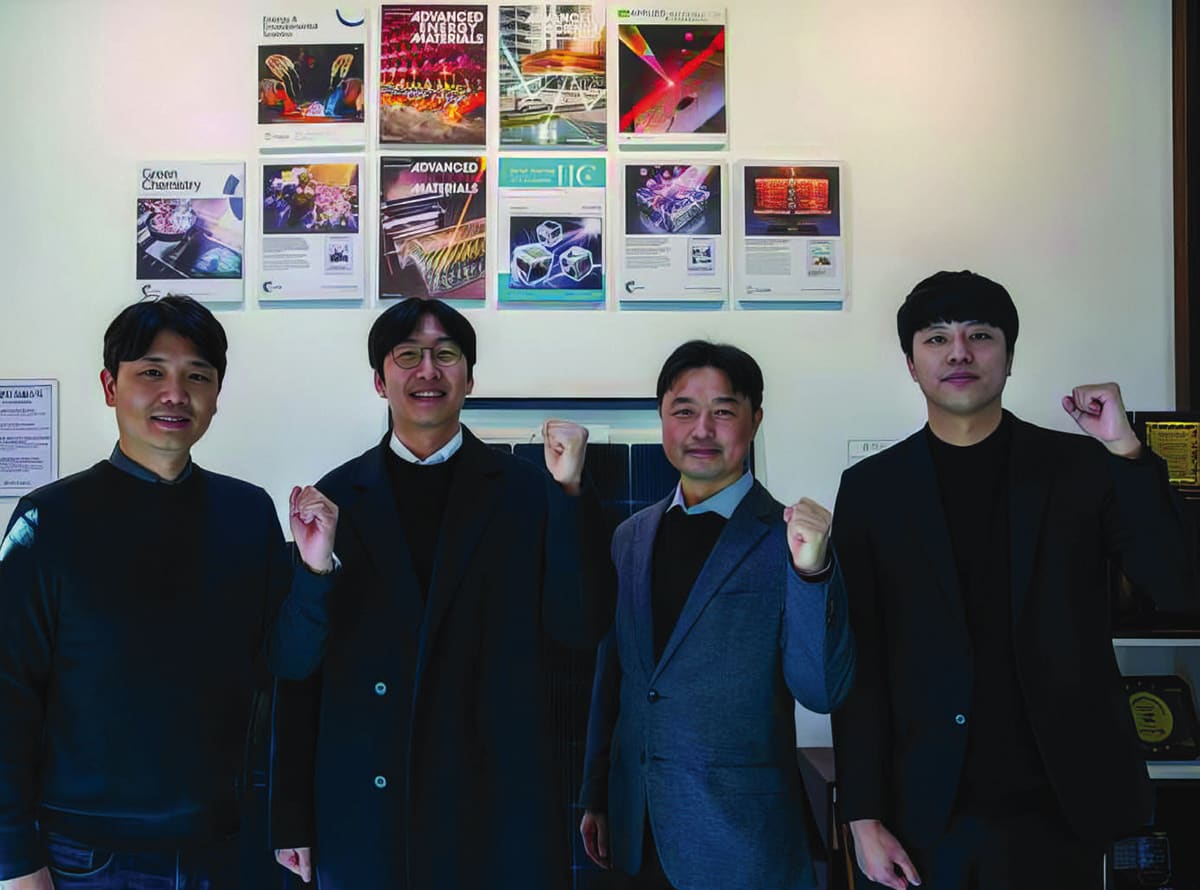
Dr. Inyoung Jeong, who led the study, stated, “This research is a key achievement that demonstrates the commercial potential of next-generation high-efficiency solar cell technology with flexibility and lightness,” adding, “It serves as an important milestone toward realizing ultralight, flexible solar cells with 30 percent efficiency in the future.”
Dr. Kihwan Kim, principal investigator of the study, stated, “The power-to-weight ratio of the fabricated solar cell is approximately 10 times higher than that of perovskite/silicon tandem solar cells, making it highly promising for applications in fields that require ultralight solar modules, such as building exteriors, vehicles, and aerospace.” He added, “By advancing large-area fabrication processes and improving stability, we aim to strengthen the competitiveness of related industries and significantly contribute to the expansion of renewable energy adoption.”
For more information, contact Inyoung Jeong at