
Moth-Like Drone

Researchers at the University of Cincinnati are developing a drone with flapping wings that can locate and hover around a moving light like a moth to a flame. Moths have the incredible ability to hover in place or even fly backward. They automatically make fine adjustments to compensate for wind or obstacles to remain stationary or follow a moving object. Likewise, this mothlike drone makes fine adjustments to maintain a desired attitude and distance from a light, even when the light moves. The drone simultaneously measures the performance of whatever function it is programmed to optimize, like finding a light source, to correct its course in a constant feedback loop that allows for remarkably consistent and stable flight. This research is interesting not only for what it might mean for new autonomous unmanned aerial vehicles but also how these tiny insects manage their miraculous aerobatics with brains the size of a grain of pollen.
Contact: Michael Miller
513-556-6757
This email address is being protected from spambots. You need JavaScript enabled to view it.
Metamaterial Lenses

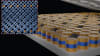
Scientists have developed a new multi-layered metalens design that could revolutionize portable optics in devices like phones, drones, and satellites. By stacking metamaterial layers instead of relying on a single one, the team overcame fundamental limits in focusing multiple wavelengths of light. Their algorithm-driven approach produced intricate nanostructures shaped like clovers, propellers, and squares, enabling improved performance, scalability, and polarization independence. The design uses layers of metamaterials to simultaneously focus a range of wavelengths from an unpolarized source and over a large diameter, overcoming a major limitation of metalenses, said the first author of the paper reporting the design, Joshua Jordaan, from the Research School of Physics at the Australian National University and the ARC Centre of Excellence for Transformative Meta-Optical Systems.
Contact: Joshua Jordaan
+61 26-1255-11
This email address is being protected from spambots. You need JavaScript enabled to view it.
Laser Wire Direct Closeout
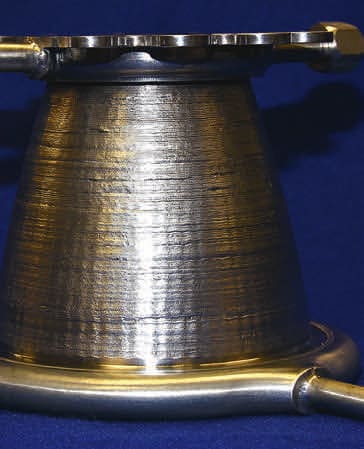
Low-cost, large-scale liquid rocket engines with regeneratively cooled nozzles will enable reliable and reduced-cost access to space. Coolant, contained under high pressure, circulates through a bank of channels within the nozzle to properly cool the nozzle walls to withstand high temperatures and prevent failure. It has been a challenge to affordably manufacture and close out the intricate nozzle channels. NASA has developed a robust and simplified additive manufacturing technology to build the nozzle liner outer jacket to close out the channels within and contain the high-pressure coolant. The new Laser Wire Direct Closeout (LWDC) capability reduces the time to fabricate the nozzle and allows for real-time inspection during the build. One variation enables a bimetallic part to help optimize material where it is needed. LWDC leverages wire freeform laser deposition to create features in place and to seal the coolant channels.