

Acquatic Robots
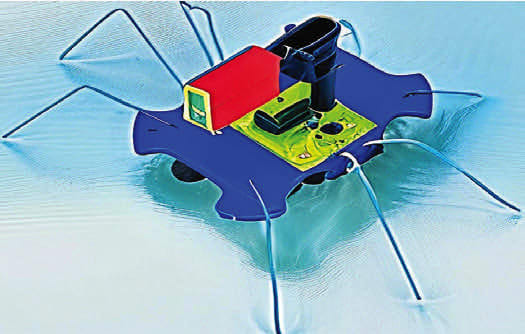
Binghamton University Professor Seokheun “Sean” Choi and his students have developed a self-powered “bug” that can skim across water. Choi had been working on bacteria-powered biobatteries that have a possible 100-year shelf life. The new aquatic robots use similar technology because it is more reliable under adverse conditions than solar, kinetic, or thermal energy systems. A Janus interface, which is hydrophilic on one side and hydrophobic on the other, lets in nutrients from the water and keeps them inside the device to fuel bacterial spore production. The team’s research showed power generation close to 1 milliwatt, which is enough to operate the robot’s mechanical movement and any sensors that could track environmental data such as water temperature, pollution levels, the movements of commercial vessels and aircraft, and the behaviors of aquatic animals.
Contact: John Brhel
607-777-2000
This email address is being protected from spambots. You need JavaScript enabled to view it.
Sweat-Powered Wearable
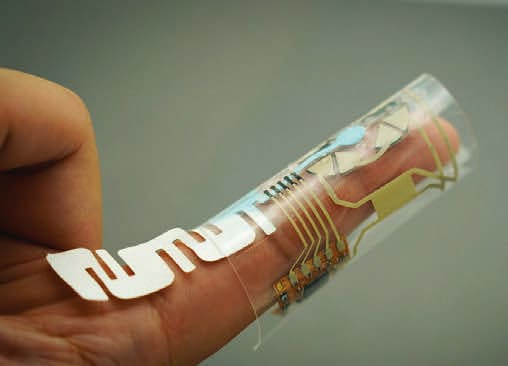
A sweat-powered wearable has the potential to make continuous, personalized health monitoring as effortless as wearing a Band-Aid. Engineers at the University of California San Diego have developed an electronic finger wrap that monitors vital chemical levels — such as glucose, vitamins, and even drugs — present in the same fingertip sweat from which it derives its energy. The device is constructed from several electronic components printed onto a thin, flexible and stretchable polymer material. Its design allows it to conform to the finger while being durable enough to withstand repeated bending, stretching and movement. Central to its operation are biofuel cells that are positioned where the device contacts the fingertip. These cells have been specially engineered to efficiently collect and convert chemicals in sweat into electricity. The team’s goal is to have autonomous power, sensing, and treatment all in one device.
Contact: Liezel Labios
858-534-3120
This email address is being protected from spambots. You need JavaScript enabled to view it.
Foot Pedal Controller
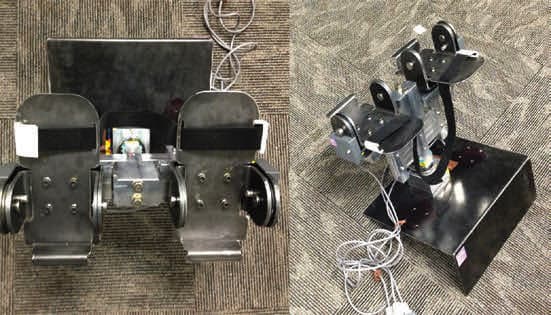
Innovators at the NASA Johnson Space Center have developed a novel foot-pedal operated system and device to control movement of an object in three-dimensional space. The Foot Pedal Controller system enables operators to control movement of spacecraft, aircraft, and watercraft using only foot pedals. This design leaves the hands free for simultaneous operation of other equipment. The Foot Pedal Controller integrates six articulating mechanisms and motion sensors and provides continuous positional feedback to the operator. Motion control across six degrees-of-freedom is enabled by three-control motions for each foot. The Foot Pedal Controller technology could be used in designs for the flight deck of the future, video game controls, drone operations, and flight simulators. It can be useful in any application where it is preferred or desirable to use the feet to control motion rather than using the hands.











