

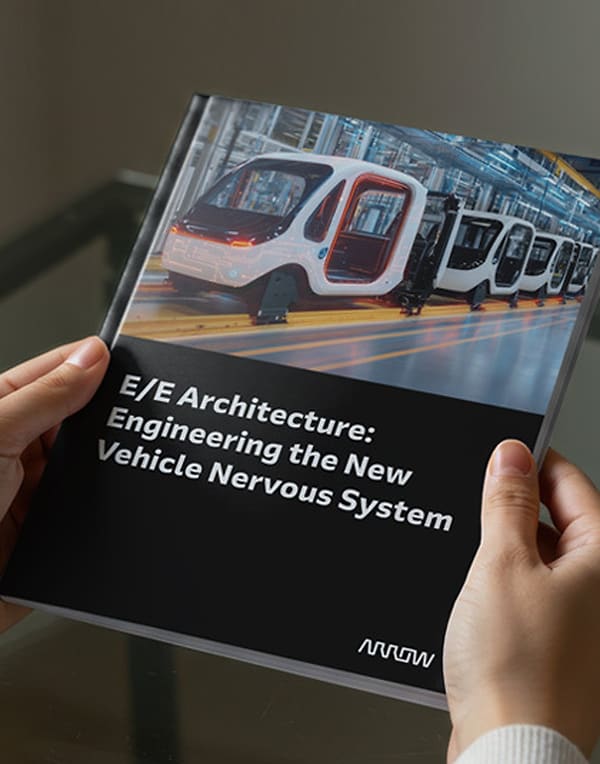
White Paper: Electronics & Computers
Engineering Insights for Zonal and Centralized Compute Designs
SPONSORED BY: ![]()

As software-defined vehicles reshape automotive design, electrical and electronic architectures must keep up. Engineers now operate in an environment where compute consolidation, network optimization, and subsystem integration have become central to platform strategy. Addressing these challenges requires a shift toward domain and zonal architectures that reduce complexity while enabling new software capabilities.
The new whitepaper adopts an engineering-first approach to E/E architecture evolution. It explains how centralized compute, high-speed networking, service-oriented frameworks, and modern safety and security models change vehicle design. You will find clear explanations of system topology options, wiring strategies, subsystem coordination, and real-world examples demonstrating implementation paths for future-ready platforms.
Don't have an account?
Overview
This document, "Arrow Engineering Insights for Zonal and Centralized Compute Designs," provides a comprehensive overview of the evolution and future trends in automotive Electrical/Electronic (E/E) architecture, emphasizing the transition towards software-defined vehicles (SDVs) and zonal architectures.
Traditional automotive E/E systems, built around numerous distributed ECUs, face limitations inThe provided document, "Arrow_Engineering-Insights-for-Zonal-and-Centralized-Compute-Designs.pdf," details the significant transformation in automotive Electrical/Electronic (E/E) architectures, driven by the rise of software-defined vehicles (SDVs), electrification, and advanced automation. It highlights a critical shift from traditional distributed architectures, which rely on hundreds of standalone Electronic Control Units (ECUs), to more integrated and efficient zonal and centralized-compute designs.
The document emphasizes that traditional architectures can no longer meet the escalating demands for compute power, data throughput, safety, and cybersecurity in modern vehicles. This has led automakers and Tier 1 suppliers to adopt unified E/E architectures centered on zonal consolidation, automotive high-performance compute (HPC), and standardized software layers.
Key benefits of this transition include significant wiring reductions (15-20%), ECU consolidation (40-70%), and new revenue opportunities through software-defined features. Zonal architecture is presented as a foundational element for scalable, modular SDVs, contributing to lower total cost of ownership (TCO) by simplifying manufacturing, maintenance, and enabling over-the-air (OTA) updates, modular upgrades, and rapid integration of Advanced Driver Assistance Systems (ADAS) and autonomous features.
The evolution of E/E architectures is traced from distributed ECU systems (early 2000s) to domain controller architectures (mid-2010s), and finally to the current zonal architecture with central HPC (2022-present). Zonal architecture reorganizes electronics by physical regions, using local zone controllers to manage sensors and actuators, while central HPCs handle advanced software workloads. This approach reduces wiring complexity, simplifies manufacturing, and abstracts software from hardware, accelerating time-to-market.
The document also delves into the impact of SDVs on E/E architecture, noting their ability to enhance user experience, safety, and operational efficiency through software flexibility. SDVs enable new business models for OEMs via software-enabled services and subscriptions. Challenges such as increased complexity, functional safety (ISO 26262), and cybersecurity (ISO/SAE 21434) are also addressed, underscoring the need for robust security measures and rigorous development processes.
Case studies illustrate the successful development of high-performance cockpit domain controllers leveraging platforms like Qualcomm Snapdragon, implementing dual operating systems (QNX for safety-critical functions and Android for infotainment) using hypervisor technology. Arrow is positioned as a key solution aggregator, offering comprehensive engineering, supply chain, certified components, integration, and lifecycle management to facilitate this industry shift.