

White Paper: Mechanical & Fluid Systems
Rightsize Your Servo Linear Actuators Accurately To Avoid Costly Design Failures
SPONSORED BY: ![]()

Relying solely on motor-based force/speed curves often leads to undersized actuators and costly system delays. This white paper explores the critical gap between theoretical motor performance and real-world integrated actuator limitations.Read our white paper to learn how to account for mechanical losses, screw thermal thresholds and duty cycle intricacies to ensure your design meets its intended L10 life.
Don't have an account?
Overview
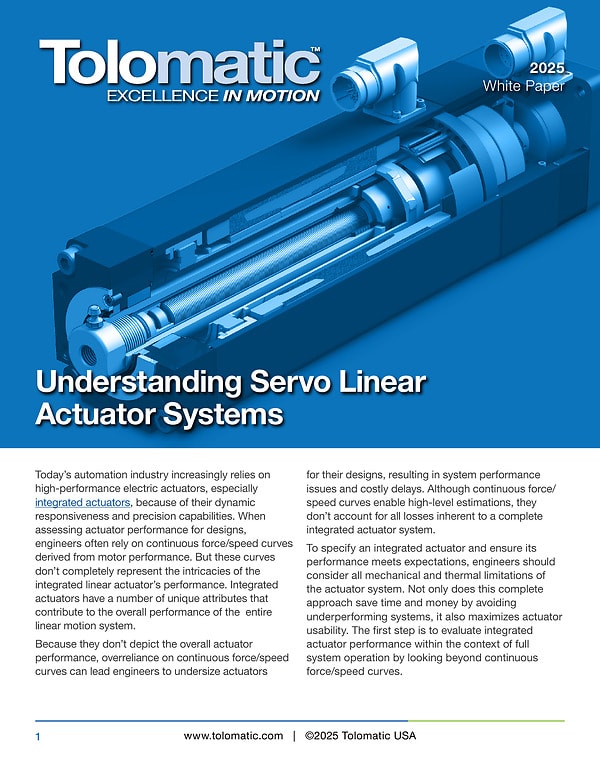
This Tolomatic white paper, "Understanding Servo Linear Actuator Systems," explains the critical considerations engineers must account for to accurately assess and specify integrated electric linear actuators in automation applications. The document highlights the limitations of the commonly used continuous force/speed curves derived solely from servo motor performance data. These standard motor-based curves do not adequately capture the complexities of integrated actuators, which include mechanical losses, thermal effects, and real-world operational conditions such as back-and-forth motion, acceleration, and deceleration.
The paper outlines that integrated actuators suffer performance reductions due to screw efficiency, heat generation, and thermal limits, especially since screws have lower thermal thresholds than motors. Ball screws typically exhibit about 90% efficiency, whereas roller screws are around 70% and have more restrictive thermal limits affecting overall system performance and actuator lifespan. To provide a realistic performance prediction, the paper advises incorporating physical and thermal limitations into the performance curves, which offers a more comprehensive representation of system capabilities.
Further, the document emphasizes the importance of using actuator sizing software, such as Tolomatic’s own SizeIt or third-party options like ServoSoft, to analyze specific motion profiles and application requirements. These tools employ detailed mechanical, thermal, and motor parameter criteria—such as maximum stroke, force, velocity limits, motor voltage, torque, rpm, buckling load, critical speed, and thermal limits—to ensure the actuator selected meets application demands without premature failure.
A key metric detailed is the L10 life, which estimates the operating lifespan after which 10% of actuator screw or bearing components are expected to fail due to fatigue. The paper presents the formula for calculating L10, which relies on parameters like the dynamic load rating (DLR), equivalent dynamic load, and screw lead. Understanding load variations and calculating equivalent loads are vital for accurate life predictions.
Ultimately, the white paper advises close collaboration with manufacturers early in the design process and a comprehensive evaluation of all mechanical, thermal, and operational factors affecting actuator performance and longevity. This holistic approach prevents undersizing, enhances system reliability, reduces maintenance needs, and balances cost and performance effectively. The paper directs engineers to Tolomatic’s online tools and expert support to facilitate robust integrated actuator design decisions.