

The processes for making wine, beer, and spirits have remained relatively unchanged for centuries.
In this episode of Here’s an Idea, we look at the efforts of vineyard owners, distillers, and brewers who are discovering small ways to innovate and adjust their own crafting techniques.
We speak with former scientists and engineers who are putting their own sustainable spin on traditional ideas, using knowledge gained from their previous experience in the lab. We also learn that owning and operating a vineyard may be the ultimate retirement plan.
Listen to the episode below.
Episode highlights include:
- The process of beer-making involves a series of smaller process, two of which are fermentation and carbonation. Fermentation produces about three times the amount of carbon dioxide needed for carbonation, which just goes to waste. We talk to a team from Lawrence Livermore National Lab about their unique carbon-capturing microcapsule technology. Watch a video of the technology below.
- Russ Hamilton spent 14 years in the semiconductor industry. He tells us about transitioning into his dream job operating a net-zero vineyard on Red Mountain, in the Southeast corner of Washington State.
- Jim Batdorf from Solar Spirits shares the story of his unique career path, from chemical engineer to distiller of solar-powered spirits.
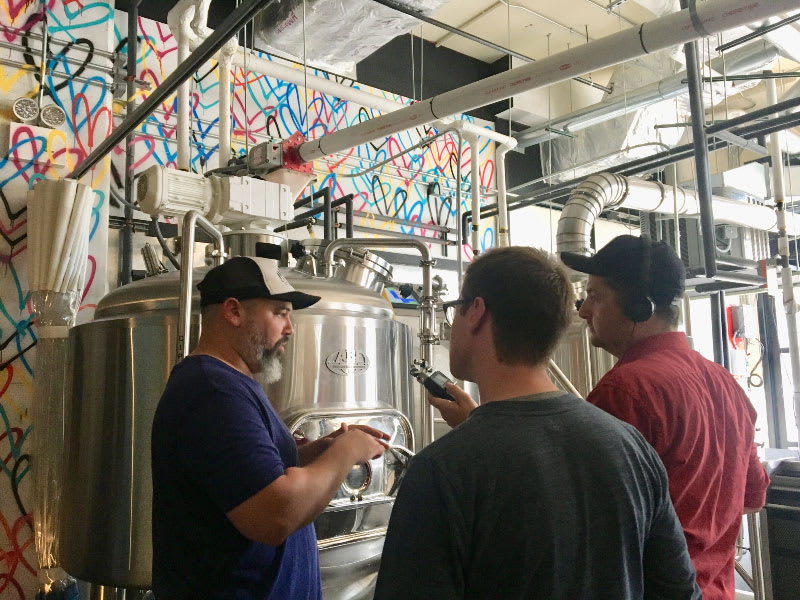
- And we take a tour of Randolph Beer in Brooklyn, NY. Before our visit, head brewer and former chemist JR warned us that, "There are some fun tricks we use through the manipulations of Newtonian physics and thermodynamics that make life easier, but to tell you the truth the brewing industry is very archaic in terms of innovation and technology." We find some truth to that statement, but also learn a lot.
Watch how the Lawrence Livermore National Lab team is adapting their carbon capture technology to craft beer making.
Get the Here's an Idea newsletter sent direct to your inbox each month.
Transcript
00:00:11 my name is Hanan and you can call me CW I'm from Lawrence Lio National Lab I'm the principal investigator of Team Max at labore my name is Lionel Kean I'm the entrepreneurial lead for the mech team team one at Lab Corp I'm currently a scientist at Lawrence Livermore National Lab at Lawrence liore National Lab our researchers have been developing Technologies to more efficiently capture
00:00:34 carbon dioxide from power plants one of the first applications we considered was actually anesthetic workstations and we figured that this would probably be an ideal application of our technology because we have certain advantages that the current state-of-the-art didn't have one of the directors in the Animal Hospital offered to purchase our material at twice the money he used to
00:00:56 pay and that was great and we really getting really excited about that but then our industrial Mentor came in and quickly pointed out that the market size in the N Market is going to be really too small for us to work on so we quickly pivoted from that and the next thing that we discovered was actually micro breweries or breweries in general because they emit so much carbon dioxide
00:01:17 our hypothesis was that smaller breweries are not employing current CO2 capture equipment because it's simply too expensive but we did know that for sure and one of the tenants of lab core is that don't guess formulate a hypothesis and verify with hard information so we went to one of the better micro breweries and POS Robel and asked them outright why aren't you doing
00:01:36 CO2 capture and they did in fact say that it was just simply too expensive for any Brewery making less than about half a million barrels so we came to this program with a technology that we think is pretty mature but during these custom interviews what we discovered is that there's still very lots of missing points or missing pieces in our whole technology in order to be actually
00:01:57 commercialized in the market and all these things that we learned from these Custer interviews help us to now go back to the lab and refine our technology to make it even more ready for the market the worst thing you can do is to waste two years of your life building something that no one will buy and labore teaches you how to evaluate whether or not someone will probably buy
00:02:17 what it is you're trying to sell and we're going to use what we learned from the labc program to continue the exploration in those fields











