
A new gradiometer scheme uses middle loops as sensing elements in low-field superconducting quantum interference device (SQUID) magnetic resonance imaging (MRI). This design of a second order gradiometer increases its sensitivity and makes it more uniform, compared to the conventional side loop sensing scheme with a comparable matching SQUID. The space between the two middle loops becomes the imaging volume with the enclosing cryostat built accordingly.
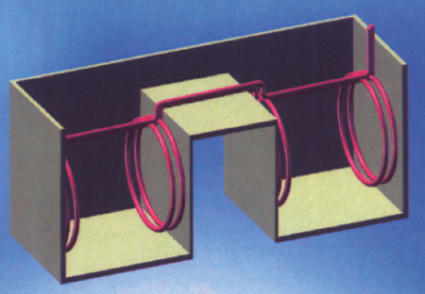
In a typical configuration of a SQUID MRI, the sensitivity of a gradiometer is a rapidly decreasing function of the distance from the sensing loops. This results in severe non-uniformity of sensitivity and signal-to-noise ratio (SNR) in the image. This problem can be solved by using two second-order gradiometers positioned at the opposite sides of the imaging volume, with two SQUIDs, one per gradiometer. This is not cost-effective since SNR improves only by a square root of two at the center of the imaging volume.
The new design, depicted in the figure, uses a single second-order gradiometer where the middle loops are used for sensing. Both the SNR and the uniformity of the gradiometer are greatly improved. In this scheme, the space between the middle loops becomes the imaging volume with the enclosing cryostat built accordingly.
Because of the sensing middle loops at both ends of the imaging volume, the sensitivity at the center of the imaging volume is twice that of conventional geometry with the same SQUID noise. Only about half of the induced energy is lost in the non-sensing loops in the new scheme. The symmetric placement of the sensing loops gives more uniform sensitivity. There is no inductance matching penalty associated with the new configuration, because the geometry and the inductance remain to be that of a single second-order gradiometer.
This work was done by Konstantin Penanen, Inseob Hahn, and Byeong Ho Eom of Caltech for NASA’s Jet Propulsion Laboratory.
In accordance with Public Law 96-517, the contractor has elected to retain title to this invention. Inquiries concerning rights for its commercial use should be addressed to:
Innovative Technology Assets Management
JPL
Mail Stop 202-233
4800 Oak Grove Drive
Pasadena, CA 91109-8099
E-mail: This email address is being protected from spambots. You need JavaScript enabled to view it.
Refer to NPO-45720, volume and number of this NASA Tech Briefs issue, and the page number.
This Brief includes a Technical Support Package (TSP).
Gradiometer Using Middle Loops as Sensing Elements in a Low-Field SQUID MRI System
(reference NPO-45720) is currently available for download from the TSP library.
Don't have an account?
Overview
The document presents a technical disclosure regarding a novel design of a second-order gradiometer intended for use in low-field superconducting quantum interference device (SQUID) magnetic resonance imaging (MRI) systems. The primary innovation involves utilizing middle loops as sensing elements, which significantly enhances the sensitivity and uniformity of the gradiometer compared to traditional side loop sensing configurations.
In conventional setups, superconducting gradiometers are employed to reject interference from distant sources, allowing for effective imaging in minimally shielded environments. However, these traditional designs face challenges, such as non-uniform sensitivity and a rapid decrease in signal-to-noise ratio (SNR) with distance from the sensing loops. The document outlines the limitations of previous designs, which often resulted in wasted induced energy in non-sensing loops and complicated inductance matching requirements.
The new design addresses these issues by employing a single second-order gradiometer with two middle loops for sensing. This configuration allows for a doubling of sensitivity at the center of the imaging volume, as the energy induced in the non-sensing loops is minimized. The symmetric placement of the sensing loops contributes to a more uniform sensitivity across the imaging volume, which is crucial for high-quality imaging results.
The document includes technical illustrations that depict the new gradiometer design and its operational principles. It emphasizes the advantages of the middle loop sensing scheme, including improved SNR and reduced inductance matching penalties, making it a more efficient and effective solution for low-field SQUID MRI applications.
Overall, this innovative gradiometer design represents a significant advancement in the field of magnetic resonance imaging, with potential implications for various scientific and medical applications. The document serves as a technical support package under NASA's Commercial Technology Program, highlighting the broader technological, scientific, and commercial applications of this development. It invites further exploration and collaboration in the field, emphasizing the importance of innovative partnerships in advancing aerospace-related technologies.