An improvement in the design and fabrication of sensing coils of superconducting quantum interference device (SQUID) magnetometers has been proposed to increase sensitivity. It has been estimated that, in some cases, it would be possible to increase sensitivity by about half or to reduce measurement time correspondingly.
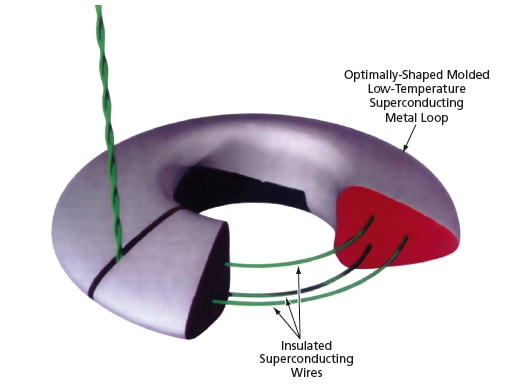
The pertinent aspects of the problems of design and fabrication can be summarized as follows: In general, to increase the sensitivity of a SQUID magnetometer, it is necessary to maximize the magnetic flux enclosed by the sensing coil while minimizing the self-inductance of this coil. It is often beneficial to fabricate the coil from a thicker wire to reduce its selfinductance. Moreover, to optimize the design of the coil with respect to sensitivity, it may be necessary to shape the wire to other than a commonly available circular or square cross-section. On the other hand, it is not practical to use thicker superconducting wire for the entire superconducting circuit, especially if the design of a specific device requires a persistent- current loop enclosing a remotely placed SQUID sensor. It may be possible to bond a thicker sensing-coil wire to thinner superconducting wires leading to a SQUID sensor, but it could be difficult to ensure reliable superconducting connections, especially if the bonded wires are made of different materials.
This work was done by Konstantin Penanen, Inseob Hahn, and Byeong Ho Eom of Caltech for NASA's Jet Propulsion Laboratory.
In accordance with Public Law 96-517, the contractor has elected to retain title to this invention. Inquiries concerning rights for its commercial use should be addressed to:
Innovative Technology Assets Management
JPL
Mail Stop 202-233
4800 Oak Grove Drive
Pasadena, CA 91109-8099
E-mail:
Refer to NPO-44397, volume and number of this NASA Tech Briefs issue, and the page number.
This Brief includes a Technical Support Package (TSP).
Improved Sensing Coils for SQUIDS
(reference NPO-44397) is currently available for download from the TSP library.
Don't have an account?
Overview
The document titled "Improved Sensing Coils for SQUIDS" from NASA's Jet Propulsion Laboratory discusses advancements in the design and construction of superconducting sensing elements, particularly focusing on Superconducting Quantum Interference Devices (SQUIDs). The primary challenge addressed is the need to maximize the magnetic flux enclosed by the sensing coil while minimizing its self-inductance, which is crucial for enhancing the performance of SQUID sensors.
To tackle this issue, the authors propose the use of larger diameter wires to reduce self-inductance. However, they note that using thicker superconducting wire throughout the entire circuit is impractical, especially when a persistent-current loop is required to connect to a remotely placed SQUID sensor. The document suggests that bonding thicker wires to thinner superconducting wire leads can be problematic due to the difficulty in achieving reliable superconducting connections between different materials.
A novel solution presented involves creating a low-melting point metal wire loop (using materials like Indium, Lead, or Lead-Tin alloy) with a large diameter and specific shapes tailored for the application. This loop can be formed on a former that encapsulates a thin superconducting wire loop by melting the metal. It is essential to leave a small vacuum or insulating gap to prevent shorting if the wire is not insulating. For applications requiring higher inductance and sensitivity, the document recommends embedding multiple thin wire loops within the molded loop, ensuring that the thin superconducting wires are insulated.
The proposed techniques have immediate applications in low-field Magnetic Resonance Imaging (MRI) systems, Magnetic Encephalography systems, and other biological magnetic probes. The authors claim that these configurations can lead to a significant sensitivity improvement of approximately 50%, which could potentially reduce imaging time by a factor of two.
Overall, the document emphasizes the importance of innovative design in optimizing superconducting sensing coils for SQUID applications, highlighting both the technical challenges and the promising solutions that can enhance the performance of these sensitive devices in various scientific and medical fields.