

Testing of victim detection radars has traditionally used human subjects who volunteer to be buried in, or climb into a space within, a rubble pile. This is not only uncomfortable, but can be hazardous or impractical when typical disaster scenarios are considered, including fire, mud, or liquid waste. Human subjects are also inconsistent from day to day (i.e., they do not have the same radar properties), so quantitative performance testing is difficult. Finally, testing a multiple-victim scenario is difficult and expensive because of the need for multiple human subjects who must all be coordinated.
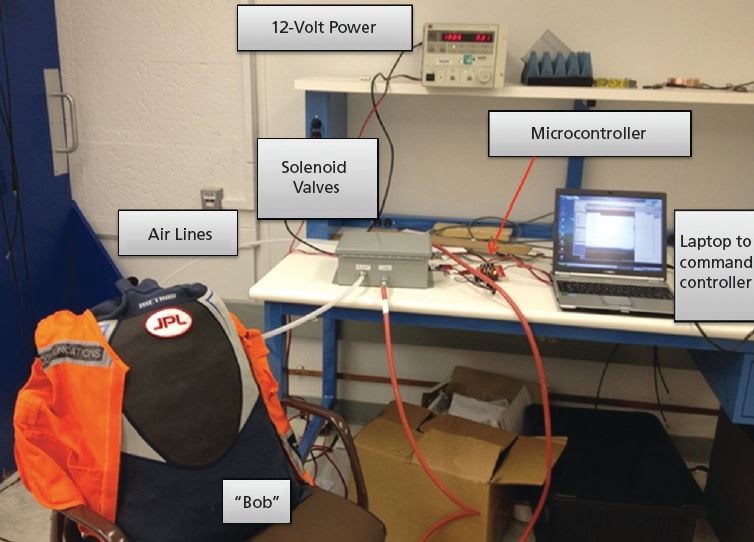
The solution is an anthropomorphic dummy with dielectric properties that replicate those of a human, and that has motions comparable to human motions for breathing and heartbeat. Two airfilled bladders filled and drained by solenoid valves provide the underlying motion for vinyl bags filled with a dielectric gel with realistic properties. The entire assembly is contained within a neoprene wetsuit serving as a “skin.” The solenoids are controlled by a microcontroller, which can generate a variety of heart and breathing patterns, as well as being reprogrammable for more complex activities.
Previous electromagnetic simulators or RF phantoms have been oriented towards assessing RF safety, e.g., the measurement of specific absorption rate (SAR) from a cell phone signal, or to provide a calibration target for diagnostic techniques (e.g., MRI). They are optimized for precise dielectric performance, and are typically rigid and immovable. This device is movable and “positionable,” and has motion that replicates the small-scale motion of humans. It is soft (much as human tissue is) and has programmable motions.
This device provides a way to characterize the performance of victim detecting radars objectively and quantitatively. It dramatically reduces the cost of testing in multiple-victim scenarios. The programmable victim simulator can be used to assess the sensitivity of the radar accurately, and can be placed for long periods of time in environments that would be unsafe for a human subject (e.g., buried for 24 to 48 hours in flowing mud, or within a burning building).
This work was done by James P. Lux and Salman Haque of Caltech; Anthony Vong of Columbus; and James Gill, Anand Gowda, and Susan Milliken of Reel EFX, Inc. for NASA’s Jet Propulsion Laboratory. NPO-48793
This Brief includes a Technical Support Package (TSP).
Victim Simulator for Victim Detection Radar
(reference NPO-48793) is currently available for download from the TSP library.
Don't have an account?
Overview
The document outlines the development and specifications of a simulated victim designed for use with victim locating radars, particularly in the low microwave frequency range of approximately 1-4 GHz. This simulated victim, referred to as "Bob," is engineered to closely mimic human anatomy and physiology, providing a realistic electromagnetic simulation for research and testing purposes.
The core of the simulator consists of a structure comparable in size to a human, filled with an electrolyte that replicates the RF properties of human tissue. The design includes air spaces to simulate lungs and actuators that mimic the motion of breathing and heartbeat, enhancing the realism of the simulation. The system is encased in a modified wetsuit that serves as a "skin," and it can be outfitted with arms, legs, and heads, allowing for the dressing of the simulated victim in typical clothing or uniforms.
The operation of the simulator is controlled by an Arduino microcontroller, which manages solenoid valves to fill and drain air bladders that simulate breathing and heartbeat. The system is designed to operate with low-pressure compressed air, providing a realistic rhythm and depth to the simulated physiological functions. The document includes diagrams illustrating the heart timing and lung contents, as well as sample test data demonstrating the simulator's performance with radar detection.
Additionally, the document references the use of appropriate dielectric simulants that have been studied extensively in the literature, ensuring that the materials used in the simulator closely match the dielectric properties of human tissue. This aspect is crucial for achieving accurate electromagnetic simulations.
The document is part of a Technical Support Package provided under NASA's Commercial Technology Program, highlighting the broader technological, scientific, and commercial applications of the research. It emphasizes the importance of this technology in victim detection scenarios, potentially aiding in search and rescue operations.
Overall, the simulated victim represents a significant advancement in the field of radar technology and victim detection, combining engineering innovation with practical applications in emergency response and safety.











