

A heterogeneous material construction has been devised for sensing coils of super-conducting quantum interference device (SQUID) magnetometers that are subject to a combination of requirements peculiar to some advanced applications, notably including low-field magnetic resonance imaging for medical diagnosis. The requirements in question are the following:
- The sensing coils must be large enough (in some cases having dimensions of as much as tens of centimeters) to afford adequate sensitivity;
- The sensing coils must be made electrically superconductive to eliminate Johnson noise (thermally induced noise proportional to electrical resistance); and
- Although the sensing coils must be cooled to below their superconducting- transition temperatures with sufficient cooling power to overcome moderate ambient radiative heat leakage, they must not be immersed in cryogenic liquid baths.
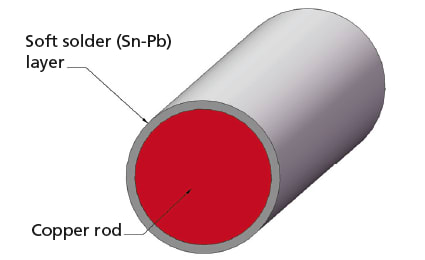
The heterogeneous material construction makes it possible to solve both the electrical- and thermal-conductivity problems. The basic idea is to construct the coil as a skeleton made of a highly thermally conductive material (typically, annealed copper), then coat the skeleton with an electrically superconductive alloy (typically, a lead-tin solder) [see figure]. In operation, the copper skeleton provides the required thermally conductive connection to the cold source, while the electrically superconductive coating material shields against Johnson noise that originates in the copper skeleton.
This work was done by Inseob Hahn, Konstantin I. Penanen, and Byeong Ho Eom of Caltech for NASA’s Jet Propulsion Laboratory.
In accordance with Public Law 96-517, the contractor has elected to retain title to this invention. Inquiries concerning rights for its commercial use should be addressed to:
Innovative Technology Assets Management
JPL
Mail Stop 202-233
4800 Oak Grove Drive
Pasadena, CA 91109-8099
E-mail:
Refer to NPO-45929, volume and number of this NASA Tech Briefs issue, and the page number.
This Brief includes a Technical Support Package (TSP).
Heterogeneous Superconducting Low- Noise Sensing Coils
(reference NPO-45929) is currently available for download from the TSP library.
Don't have an account?
Overview
The document discusses advancements in Low-Field Magnetic Resonance Imaging (MRI) systems utilizing superconducting sensing elements, specifically focusing on a novel heterogeneous construction for superconducting low-noise sensing coils. These systems are based on Superconducting Quantum Interference Devices (SQUID) and are designed to improve sensitivity while addressing challenges related to thermal management.
Traditional superconducting materials, such as niobium and lead, are limited in their application due to poor thermal conductivity and the necessity for a cold source to maintain superconductivity. The document highlights the issues faced by larger gradiometer systems, which require effective thermal connections to manage stray radiation loading and ensure quick cool-down times. To overcome these challenges, the authors propose a gradiometer constructed from a high-conductivity annealed copper skeleton, coated with a lead-tin alloy. This design allows for effective thermal conduction while maintaining low-noise performance due to the superconducting coating, which shields against thermal Johnson noise.
The primary advantage of this heterogeneous construction is its ability to provide strong conductive cooling and self-shielding from thermally induced noise, making it suitable for cryogen-free, compact MRI systems. The improved thermal conductivity of the copper skeleton facilitates shorter initial cool-down times and helps maintain the temperature of the sensing coil below the superconducting transition of the lead-tin alloy, even under moderate radiative thermal loads.
The document emphasizes the potential applications of this technology beyond MRI, suggesting its use in various cryogenic magnetometry applications. The innovative design represents a significant advancement in the field, addressing fundamental difficulties associated with conventional superconducting wires in environments with high radiative heat loading.
Overall, the document outlines a promising approach to enhancing the performance of superconducting sensing systems, paving the way for more efficient and effective medical diagnostic tools and other applications requiring high sensitivity and low noise in cryogenic conditions. The work is attributed to inventors from NASA's Jet Propulsion Laboratory, showcasing the intersection of aerospace technology and medical imaging advancements.











