Several techniques for manipulating neutral atoms (more precisely, ultracold clouds of neutral atoms) in chip-based magnetic traps and atomic waveguides have been demonstrated. Such traps and waveguides are promising components of future quantum sensors that would offer sensitivities much greater than those of conventional sensors. Potential applications include gyroscopy and basic research in physical phenomena that involve gravitational and/or electromagnetic fields. The developed techniques make it possible to control atoms with greater versatility and dexterity than were previously possible and, hence, can be expected to contribute to the value of chip-based magnetic traps and atomic waveguides.
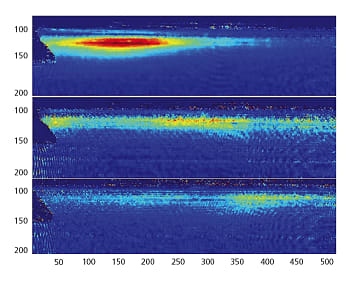
The methods are best explained in terms of examples. Rather than simply allowing atoms to expand freely into an atomic waveguide, one can give them a controllable push by switching on an externally generated or a chip-based gradient magnetic field. This push can increase the speed of the atoms, typically from about 5 to about 20 cm/s. Applying a non-linear magnetic-field gradient exerts different forces on atoms in different positions — a phenomenon that one can exploit by introducing a delay between releasing atoms into the waveguide and turning on the magnetic field.
Before the magnetic field is turned on, the fastest atoms move away from the region where the gradient will be the strongest, while the slower atoms lag behind, remaining in that region for a while. Hence, once the magnetic field is turned on, it can be expected to push the slower atoms harder than it will push the faster atoms. By controlling the amplitude and delay of the gradient, one can tailor the push so as to cause the slower atoms to catch up with the faster ones at a chosen location along the waveguide, thereby effectively focusing the atoms (in other words, greatly increasing the density of the cloud of atoms) at that location. Of course, in addition, the acceleration of the slower atoms effectively raises the temperature of the cloud of atoms. In a proposed variant of this accelerating-and-focusing technique, the gradient would be suitably repositioned along the waveguide and its amplitude and timing suitably altered, so as to preferentially decelerate the faster atoms, thereby effectively cooling the cloud of atoms.
This work was done by David Aveline, Robert Thompson, Nathan Lundblad, Lute Maleki, Nan Yu, and James Kohel of Caltech for NASA’s Jet Propulsion Laboratory. NPO-43015
This Brief includes a Technical Support Package (TSP).
Manipiulating Neutral Atoms in Chip-Based Magnetic Traps
(reference NPO-43015) is currently available for download from the TSP library.
Don't have an account?
Overview
The document discusses advancements in manipulating neutral atoms within chip-based magnetic traps, specifically focusing on techniques developed to enhance control over atoms once they are loaded into an atomic waveguide. The primary goal of this research is to provide physicists with tools that significantly improve the manipulation of atomic motion, which could have substantial implications for future technologies, including quantum sensors.
The solution presented involves the use of both external and chip-based magnetic fields to control the motion of atoms in a waveguide. The researchers have developed several innovative techniques that allow for the manipulation of atomic speed and density. Instead of allowing atoms to expand freely, the team can apply a controllable push by activating either an external gradient or a chip-based gradient. This method increases the mean speed of the atoms from approximately 5 cm/sec to about 20 cm/sec.
A key aspect of this technique is the differential effect of the applied gradient on atoms located at different spatial positions. By introducing a delay between the release of atoms into the waveguide and the application of the gradient, the researchers can create a scenario where faster atoms move away from the strongest gradient region, while slower atoms lag behind. This manipulation allows for the focusing of atoms, effectively increasing their density at a controllable location within the waveguide.
Additionally, the researchers propose that by repositioning the external gradient, they can cool the atoms using a similar technique. The delay and amplitude of the gradient can be adjusted to preferentially slow down the fastest atoms, thereby lowering the overall temperature of the atomic ensemble.
This work is notable as it addresses the manipulation of atomic density and temperature within a waveguide, an area that has garnered significant interest in recent years due to the potential applications in quantum technology. The document references a paper titled “Loading, Guiding and Manipulating Neutral Atoms in Atom Chip Magnetic Traps” by a team of researchers, which was presented at the CLEO/QELS 2006 conference.
Overall, the document highlights a pioneering approach to atom manipulation that could lead to advancements in quantum sensors and other related technologies, showcasing the innovative research being conducted at NASA's Jet Propulsion Laboratory.