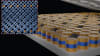

Projection photolithography has been used as a fabrication method for radial grove gratings. Use of photolithographic method for diffraction grating fabrication represents the most significant breakthrough in grating technology in the last 60 years, since the introduction of holographic written gratings. Unlike traditional methods utilized for grating fabrication, this method has the advantage of producing complex diffractive groove contours that can be designed at pixel-by-pixel level, with pixel size currently at the level of 45×45 nm. Typical placement accuracy of the grating pixels is 10 nm over 30 nm. It is far superior to holographic, mechanically ruled or direct e-beam written gratings and results in high spatial coherence and low spectral cross-talk. Due to the smooth surface produced by reactive ion etch, such gratings have a low level of randomly scattered light. Also, due to high fidelity and good surface roughness, this method is ideally suited for fabrication of radial groove gratings. The projection mask is created using a laser writer. A single crystal silicon wafer is coated with photoresist, and then the projection mask, with its layer of photoresist, is exposed for patterning in a stepper or scanner. To develop the photoresist, the fabricator either removes the exposed areas (positive resist) of the unexposed areas (negative resist). Next, the patterned and developed photoresist silicon substrate is subjected to reactive ion etching. After this step, the substrate is cleaned. The projection mask is fabricated according to electronic design files that may be generated in GDS file format using any suitable CAD (computer-aided design) or other software program.
Radial groove gratings in off-axis grazing angle of incidence mount are of special interest for x-ray spectroscopy, as they allow achieving higher spectral resolution for the same grating area and have lower alignment tolerances than traditional in-plane grating scheme. This is especially critical for NASA Constellation-X project that will utilize hundreds of gratings all of which need to be precisely aligned for x-ray observation of space.
This work was done by Dmitri Iazikov and Thomas W. Mossberg of LightSmyth Technologies for Goddard Space Flight Center. For further information, contact the Goddard Innovative Partnerships Office at (301) 286- 5810. GSC-15686-1