A micromachining-based fabrication process has been proposed for low-volume production of copies of a mesoscale vibratory gyroscope. The process would include steps of photolithography, metallization, deep reactive-ion etching (RIE), Au/Au thermal-compression bonding, and anodic bonding. In the present state of the art, these process steps are well established and the process as a whole would be considered reproducible.
The basic designs and principles of operation of micromachined vibratory gyroscopes were discussed in several prior NASA Tech Briefs articles. For the purpose of the present discussion, the relevant micromachined components of the mesoscale vibratory gyroscope to be fabricated would be a baseplate; a resonator to be mounted on the baseplate; and a post to be affixed to (and thereby become part of) the resonator.
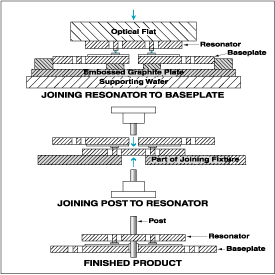
The figure depicts the last joining steps. The resonator would be joined to the baseplate by thermal-compression bonding of surface gold layers on their mating metal bonding pads, at a temperature of 350 °C. Top and bottom parts of the post would be joined to the upper and lower surfaces, respectively, of the resonator by anodic bonding at a potential of 4.25±0.25 kV and temperature of Å400 °C.
This work was done by Kirill Shcheglov of Caltech for NASA's Jet Propulsion Laboratory. For further information, access the Technical Support Package (TSP) free on-line at www.nasatech.com/tsp under the Manufacturing category.
In accordance with Public Law 96-517, the contractor has elected to retain title to this invention. Inquiries concerning rights for its commercial use should be addressed to
Intellectual Assets Office
JPL
Mail Stop 202-233
4800 Oak Grove Drive
Pasadena, CA 91109
(818) 354-2240
E-mail:
Refer to NPO-30288, volume and number of this NASA Tech Briefs issue, and the page number.
This Brief includes a Technical Support Package (TSP).
Micromachining of a Mesoscale Vibratory Gyroscope
(reference NPO-30288) is currently available for download from the TSP library.
Don't have an account?
Overview
The document is a technical support package prepared under the sponsorship of the National Aeronautics and Space Administration (NASA) and details the development of a mesoscale vibratory gyroscope. Authored by Kirill V. Shcheglov and published in the NASA Tech Brief Vol. 26, No. 12, it outlines a novel fabrication process aimed at creating high-performance miniature gyroscopes.
The report begins by emphasizing the need for a reliable and efficient fabrication method for mesoscale micromachined gyroscopes, which are critical for various applications in aerospace and other fields. The motivation behind this work stems from the challenges faced in producing such devices with the required precision and performance.
The solution presented involves a combination of advanced manufacturing techniques, including photolithography, metallization, and deep reactive ion etching (RIE). These methods allow for the precise fabrication of the gyroscope's components. The assembly of these components is achieved through Au/Au thermal compression bonding and anodic bonding, ensuring a robust and reliable final product.
The document highlights the novelty of the approach, noting that the fabrication process is not only simple but also reproducible, which is essential for scaling production and ensuring consistency in performance. This innovation represents a significant improvement over prior art in the field of gyroscope manufacturing.
Additionally, the report includes a disclaimer stating that references to specific commercial products or processes do not imply endorsement by the U.S. Government or the Jet Propulsion Laboratory. It also clarifies that the work was conducted at the Jet Propulsion Laboratory under a contract with NASA.
Overall, this technical support package serves as a comprehensive overview of the advancements in micromachining technology for gyroscopes, showcasing the potential for high-performance applications in various sectors. The combination of innovative fabrication techniques and the emphasis on reproducibility positions this work as a significant contribution to the field of aerospace technology and beyond.