Previously, it was difficult to fabricate deformable mirrors made by piezoelectric actuators. This is because numerous actuators need to be precisely assembled to control the surface shape of the mirror. Two approaches have been developed. Both approaches begin by depositing a stack of piezoelectric films and electrodes over a silicon wafer substrate. In the first approach, the silicon wafer is removed initially by plasma-based reactive ion etching (RIE), and non-plasma dry etching with xenon difluoride (XeF2). In the second approach, the actuator film stack is immersed in a liquid such as deionized water. The adhesion between the actuator film stack and the substrate is relatively weak. Simply by seeping liquid between the film and the substrate, the actuator film stack is gently released from the substrate.
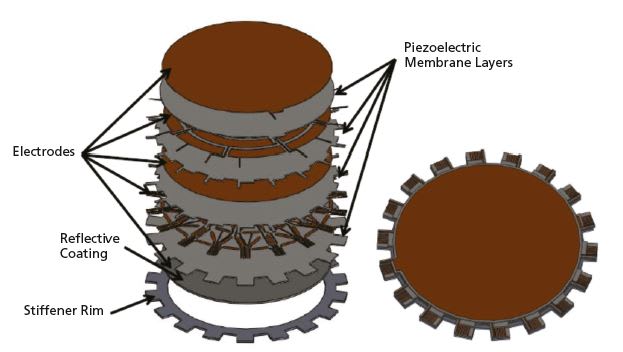
In the first approach, the actuator film stack is prepared on SOI substrate. Then, the thick silicon (typically 500-micron thick and called handle silicon) of the SOI wafer is etched by a deep reactive ion etching process tool (SF6-based plasma etching). This deep RIE stops at the middle SiOM2 layer. The middle SiO2 layer is etched by either HF-based wet etching or dry plasma etch. The thin silicon layer (generally called a device layer) of SOI is removed by XeF2 dry etch. This XeF2 etch is very gentle and extremely selective, so the released mirror membrane is not damaged. It is possible to replace SOI with silicon substrate, but this will require tighter DRIE process control as well as generally longer and less efficient XeF2 etch.
In the second approach, the actuator film stack is first constructed on a silicon wafer. It helps to use a polyimide intermediate layer such as Kapton because the adhesion between the polyimide and silicon is generally weak. A mirror mount ring is attached by using adhesive. Then, the assembly is partially submerged in liquid water. The water tends to seep between the actuator film stack and silicon substrate. As a result, the actuator membrane can be gently released from the silicon substrate. The actuator membrane is very flat because it is fixed to the mirror mount prior to the release.
Deformable mirrors require extremely good surface optical quality. In the technology described here, the deformable mirror is fabricated on pristine substrates such as prime-grade silicon wafers. The deformable mirror is released by selectively removing the substrate. Therefore, the released deformable mirror surface replicates the optical quality of the underlying pristine substrate.
This work was done by Risaku Toda, Victor E. White, Harish Manohara, Keith D. Patterson, Namiko Yamamoto, Eleftherios Gdoutos, John B. Steeves, Chiara Daraio, and Sergio Pellegrino of Caltech for NASA’s Jet Propulsion Laboratory.
In accordance with Public Law 96-517, the contractor has elected to retain title to this invention. Inquiries concerning rights for its commercial use should be addressed to:
Innovative Technology Assets Management
JPL
Mail Stop 321-123
4800 Oak Grove Drive
Pasadena, CA 91109-8099
E-mail: This email address is being protected from spambots. You need JavaScript enabled to view it.
NPO-48665
This Brief includes a Technical Support Package (TSP).
Fabrication Methods for Adaptive Deformable Mirrors
(reference NPO-48665) is currently available for download from the TSP library.
Don't have an account?
Overview
The document titled "Fabrication Methods for Adaptive Deformable Mirrors" is a technical support package from NASA's Jet Propulsion Laboratory (JPL), detailing innovative techniques for creating adaptive deformable mirrors (ADMs). These mirrors are crucial in various applications, particularly in aerospace, where precise control of light and imaging is required.
The document outlines two primary fabrication methods for ADMs: the water delamination approach and the deep reactive ion etching (DRIE) combined with XeF2 etching. The water delamination method allows for the creation of deformable mirrors with high precision, while the DRIE method provides a robust alternative for producing mirrors with intricate designs.
Key findings include the performance characteristics of the fabricated mirrors. For instance, the document reports that mirrors made using the water delamination approach can achieve approximately 100 micrometers of deflection at the center point when a voltage of up to ±500 volts is applied. This demonstrates good piezoelectric linearity and very low hysteresis, indicating that the mirrors can respond accurately and consistently to electrical inputs.
The document emphasizes the significance of these fabrication methods in advancing the technology of adaptive optics, which is essential for improving imaging systems in telescopes, satellites, and other optical devices. The ability to manipulate light with high precision can enhance the performance of these systems, leading to better data collection and analysis in scientific research and exploration.
Additionally, the document serves as a resource for those interested in the commercial applications of these technologies, highlighting the potential for broader use beyond aerospace. It encourages collaboration and innovation through the NASA Innovative Partnerships Office, which aims to facilitate the transfer of technology developed at NASA to the commercial sector.
Overall, this technical support package provides valuable insights into the state-of-the-art fabrication techniques for adaptive deformable mirrors, showcasing their potential impact on various fields, including aerospace, optics, and beyond. The research and development efforts documented here reflect NASA's commitment to advancing technology for scientific and commercial applications.