

Concrete is the second most-consumed resource on Earth after water, with a global production that exceeds 16 billion metric tons per year. One way to decrease the material's carbon footprint: Make sure it doesn't break.
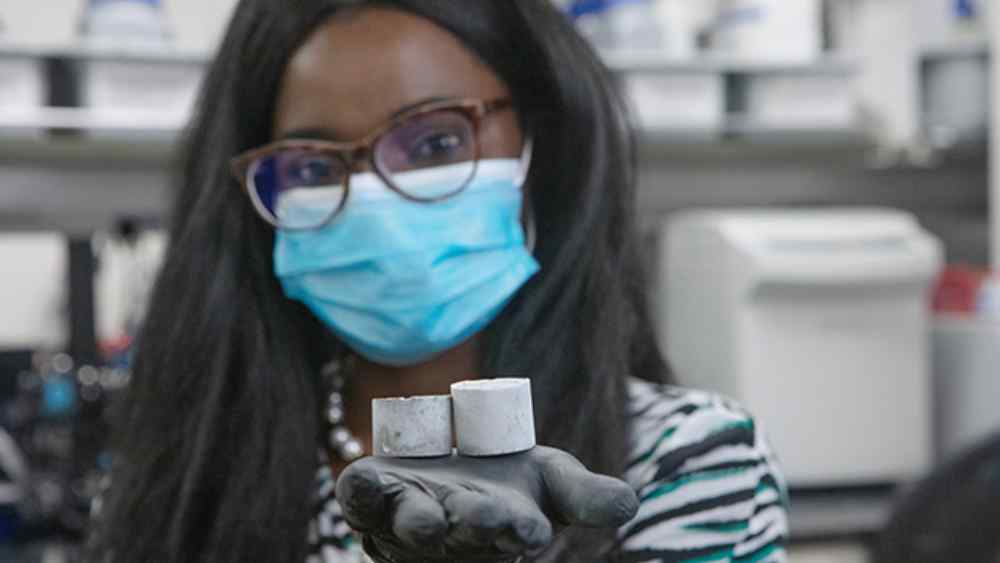
By introducing nanoparticles into ordinary cement, a Northwestern University lab, led by civil and environmental engineering professor Ange-Therese Akono, has formed a more durable, multi-functional building material.
The Northwestern team's research was published this month in the journal Philosophical Transactions of the Royal Society A .
Akono, the lead author of the study, examined the particles' impact on fracture behavior.
With an innovative analysis method called "scratch testing," Akono investigated two types of nanoparticles, and their impact on cement strength. Graphene nanoplatelets – both open flakes and rolled-up tubes – demonstrated high fracture toughness, due to their larger surface area and thickness.
“The role of nanoparticles in this application has not been understood before now, so this is a major breakthrough,” Akono said in a recent news release . “As a fracture mechanics expert by training, I wanted to understand how to change cement production to enhance the fracture response.”
Akono’s lab efficiently formed predictions on the material’s properties in a fraction of the time. The scratch test measures fracture response by applying a conical probe with increasing vertical force against the surface of microscopic bits of cement. Fracture toughness is then computed using a nonlinear fracture mechanics model.
Akono, who developed the novel method during her Ph.D. work, said the process requires less material and accelerates the discovery of new ones.
“I was able to look at many different materials at the same time,” Akono said . “My method is applied directly at the micrometer and nanometer scales, which saves a considerable amount of time. And then based on this, we can understand how materials behave, how they crack and ultimately predict their resistance to fracture.”
Graphene nanoplatelets were shown to improve the resistance to fracture of ordinary cement. Incorporating a small amount of the nanomaterial improved water transport properties, including pore structure and water penetration resistance, with reported relative decreases of 76% and 78%, respectively.
Through scratch testing, the nanomaterials bridged nanoscale air voids, leading to pore refinement, and a decrease in the material's porosity and the water absorption. The study noted a positive correlation between the fracture toughness and the mass fraction of nanofiller for graphene-reinforced cement.
Learn more about graphene-reinforced cement. Read the report .
In a short Q&A with Tech Briefs below, Prof. Akono explains what makes this kind of cement so important as the population expands.
Tech Briefs: What makes the cement “smart?” so to speak?
Prof. Ange-Therese Akono: The cement is smart due to its broad multifunctionality. Some potential applications include structural health monitoring, electromagnetic interference, and portable batteries. These applications are possible thanks to a wide array of unique properties such as electrical conductivity, magnetic conductivity, piezoelectric properties, high water penetration resistance, high mechanical performance, and low carbon footprint.
Tech Briefs: Can you provide a few specific details about what the “nanoparticles” are? What is special about these nanoparticles, and what inspired you to add them and go with this approach?
Prof. Ange-Therese Akono: The nanoparticles are carbon-based nanomaterials such as graphene nanoplatelets or carbon nanofibers. What is unique about these nanoparticles is their high strength and their nanoscale structure.
Basically, the idea is to learn from nature. Natural materials such as bone are intrinsically multifunctional, strong, and tough, thanks to a sophisticated architecture that integrates several levels of structural hierarchy along with a hybrid composition, organic-inorganic. In this case, we choose our nanoparticles to replicate that multiscale structure and organic-inorganic composition to yield advanced cement.
Tech Briefs: The alternative approach, says the news release , has been to increase the amount of carbon. Can you tell me more about this process, how it works, and why your method is a better alternative?
Prof. Ange-Therese Akono: The conventional approach to achieve higher performance is to increase the volume of cement, for instance, to sustain higher loads. This approach, in turn, leads to bulky structures with thick sections and a high carbon footprint. The other issue is the high susceptibility of current cement to cracking and its high porosity and low water penetration resistance, limitations that drive up the maintenance costs over the lifetime of the structure.
In contrast, we leverage nanoscience and nanotechnology to yield a new structural design for cement at the nanoscale, that is denser, with a higher water penetration resistance and increased mechanical properties. The key point is to change the distribution of the basic building block of cement using nanoparticles and advanced processing. Thus, we reinforce the cement directly at the fundamental scale, nanoscale and below, to drastically enhance the performance at the structural level.
Tech Briefs: What needs to happen before this material can start getting used in cities?
Prof. Ange-Therese Akono: We are currently investigating the long-term performance and the durability of our novel nano-cement. We will then proceed to further testing at the structural level, where the focus will be on scaling up our novel manufacturing process and leveraging the multifunctionality of our material.
Tech Briefs: Why is this kind of material so valuable?
Prof. Ange-Therese Akono: Our material is valuable as it provides an advanced construction material solution to promote urban expansion while mitigating climate change. The world population is growing exponentially and being concentrated mainly in cities. This rapid urbanization calls for advanced construction materials to meet the needs of this expanding population without straining existing urban resources in terms of infrastructures and buildings.
Another challenge is to mitigate climate change by reducing the carbon footprint. Currently, the cement industry accounts for 8% of man-made greenhouse gas emissions. We meet both challenges through a novel material with enhanced performance, a low carbon footprint, and a high multifunctionality, to promote advanced sensing and connectivity.
What do you think? Share your questions and comments below.
Transcript
00:00:00 [Music] it's one of the most common construction materials in the world cheap strong and easily made concrete allows cities to reach the sky levees to hold back floodwaters and roads to stretch across the land for pouring the concrete in a TT form which is a parking garage product concrete technology dates back
00:00:44 at least as far as the ancient Romans and today at places like the Yunus rest corporation in pittsfield massachusetts where rick Patrika works it is still mixed with the same three basic ingredients water a cement binder and gravel when we mined this from the earth it's actually made up of boulders cobblestones on its surface concrete hardly seems the stuff of innovation but
00:01:11 in fact it's an example of how the innovation process sometimes works whereby a scientist engineer or inventor makes an important discovery and then must figure out how it can be used to improve something Debra Cheung is one such innovator I was really the oddball in concrete research community Chong is an nsf-funded scientist at the State University of New York at Buffalo with
00:01:35 an expertise in composite materials and structural science at her lab Cheung wondered what would happen if she added a new material to concrete carbon fibers a material that conducts electricity and consists of strands of carbon atoms in the very beginning I was just thinking of trying to use carbon fiber in and it's different beasts namely cement in early tasks Chung discovered that if
00:02:02 she added carbon fibers to concrete the electrical properties of the structure would change the fibers don't need to touch instead their contact with the hardened cement allows the entire structure to conduct electricity the fibers can greatly affect the electrical properties not only making it more conductive but making it able to have its electrical resistance change in
00:02:26 response to damage or defamation and that makes the concrete a sensor this also makes concrete structures that are smart able to detect even my new changes in the amount of stress inside them having made the discovery Cheung wondered if it might help tackle a major problem that engineers like Patrika face when building with concrete the need to regularly monitor structures for signs
00:02:50 of cracking or stress typically historically it's through inspection and you're looking for the crack after the fact what's really needed is some automatic way that you can monitor that in real time as this experiment demonstrates by attaching a meter to a sample of concrete Chung can measure the precise amount that the smart concrete deforms
00:03:18 as a hydraulic press punches down on it the amount of deformation step by step and that's why the resistance decrease which occurs every time you compress as the slab is compressed the electrical properties of the sample changes causing it to become slightly more conductive as the electrical resistance decreases the quality of the touching between the fiber and the cement matters a great
00:03:48 deal - how effective the fiber is in influencing the conductivity of the entire stuff at ten thousand pounds of pressure about as heavy as a full-grown elephant the sample finally cracks with the ability to monitor the hidden stresses inside concrete chung says smart concrete may be able to lead engineers to trouble spots in their structures long before crack is ever
00:04:14 visible to the human eye after I realized that this resistance change is so much so sensitive a sensor that there's something in it that's valuable realizing the value of her discovery Chung took an important step to protect the idea by filing a patent application at the US Patent and Trademark Office in 1998 she was granted a patent for what is referred to as a composite material
00:04:40 strain stress sensor or what Chung likes to call smart concrete while smart concrete has not yet made it to market engineers like Rick patrika say such innovations would be welcomed those things that we can use to detect things that we can't see are really innovative more than just a breakthrough the discovery of smart concrete is an example of how modern technology
00:05:05 combined with an innovative approach can enhance a material that has been used for centuries you











