

As recent events in Haiti and Argentina have highlighted, many urban buildings in seismically active regions worldwide are in need of reinforcement to resist earthquake damage. One challenge facing earthquake retrofit activities is finding a balance between the cost and the effectiveness of the methods to be used. As part of its efforts to verify the efficiency and accuracy of new Italian regulations for the seismic assessment and repair to existing buildings, the European Centre for Training and Research in Earthquake Engineering (EUCENTRE, Pavia, Italy) used machine vision as a no-contact measurement system.

Classical Methods Have Limits

While these instruments can provide highly precise, real-time measurements of building flexure and movement, they have their drawbacks. For one, these devices must be rigidly attached to the structure in order to make measurements. In the case of strain gauges, this requires attaching the gauge to the steel bar before pouring the concrete to construct the building. For displacement transducers, this requires bolting both transducer ends to structural elements. Another drawback is that strain gauges and displacement transducers only measure local displacement along a single axis, requiring researchers to choose carefully the mounting location and orientation of these instruments. In the case of strain gauges, this placement cannot be changed later, as it is sealed in concrete.
Accelerometers allow greater positioning flexibility because they can be mounted anywhere, needing only one anchor point, and can be moved with relative ease. Unfortunately, they cannot directly measure displacement, and the signal integration needed to obtain displacement introduces errors and uncertainties into the results.
All these instrumentation methods have the additional drawback that they require wiring to bring their signals to a data acquisition system, increasing the installation effort and cost. This cost adds to the cost of the instruments themselves, with the result that researchers must often make a tradeoff between the number of measurement sites and the cost to acquire and install the instruments.
Vision Simplifies Measurement

The vision system that EUCENTRE developed consisted of as many as ten standalone image acquisition and analysis units with a common electrical trigger to synchronize data acquisition. Each unit included one or two DALSA Pantera cameras with 2352 × 1728 resolution and 120 frame/second acquisition speed, a PC with two RAID-0 300-GB hard disk drives, and an Xcelera X64 frame grabber connected into the PC’s 4x PCIExpress socket. All units connected to a network that provided remote system control and database storage capability.
To provide complete monitoring of building motion during excitation, unit cameras imaged key points within the building’s structure, including the base of support columns and the junctures of the floors and ceilings with the support columns (Figure 1). A pattern of reflective markers within each field of view provided the analysis system with measurement points that it could use to calculate both motion and distortion within the structure. Each pattern allowed the determination of local effects, and correlation of data among the synchronized units allowed the determination of global effects.
One of the challenges the vision system needed to overcome was the effect of environmental illumination. The greater the contrast between the marker and the background, the faster and more reliably the vision system could identify the markers and measure their position. In some configurations, however, the environmental illumination could wash out marker visibility (Figure 2a). To resolve this problem, the researchers mounted infrared filters in the cameras to eliminate ambient light from the image, and used infrared lamps to ensure controlled illumination of the markers. The result was a significant increase in marker visibility (Figure 2b) and, thus, enhanced measurement speed and accuracy.
High Precision and Accuracy
The host CPU’s processing power limited the number of markers that a unit could work with. Within that limit, however, the cameras and analysis units could identify markers on the structure anywhere within their field of view and calculate their absolute coordinates at a frequency of 60 Hz. For finer time resolution, the system could work with any 2-Mpixel rectangular area within the field of view at a frequency, and achieve a measurement speed of 120 Hz. These speeds were more than adequate to measure the typical vibration frequencies of building seismic responses.
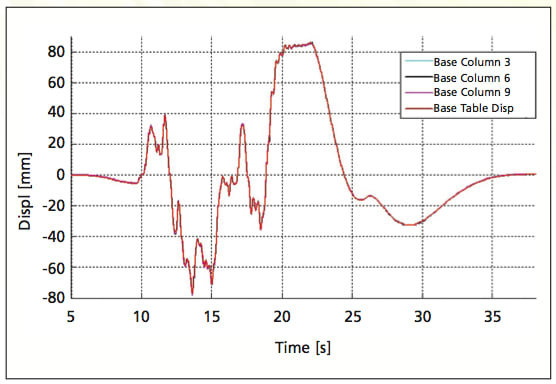
In order to test the accuracy of this innovative optical measurement system, EUCENTRE compared the movement results for the bases of the building’s support columns against the known movement of the shake table to which they were attached. Under low acceleration conditions, the column bases should undergo simple rigid translation, so that their movements should correspond to the table’s movement. As shown in Figure 4, the results were a nearly perfect match.
Machine vision has thus added an important new tool to earthquake retrofit evaluation. Because it relies simply on the placement of markers, optical instrumentation is relatively quick and inexpensive to install. Further, measurement sites are readily modified and augmented, allowing researchers to explore unanticipated regions of interest that may arise during testing. The high performance of modern, high-definition digital cameras and image processing systems provides speed, precision, and accuracy comparable to traditional methods. The result is that machine vision provides a relatively low-cost, easy-to-install method for the measurement and analysis of structural motion.
This article was written by Jean-Pierre Luevano, International Sales Manager at DALSA (Montreal, Canada), and Marco Diani, Owner of Image S (Milan, Italy). For more information, Click Here .







