A proposed integrated circuit based on quantum-dot cellular automata (QCA) would function as a bit-serial adder. This circuit would serve as a prototype building block for demonstrating the feasibility of quantum-dots computing and for the further development of increasingly complex and increasingly capable quantum-dots computing circuits. QCA-based bit-serial adders would be especially useful in that they would enable the development of highly parallel and systolic processors for implementing fast Fourier, cosine, Hartley, and wavelet transforms.
The proposed circuit would complement the QCA-based circuits described in "Implementing Permutation Matrices by Use of Quantum Dots" (NPO-20801), NASA Tech Briefs, Vol. 25, No. 10 (October 2001), page 42, and the preceding article. Those articles described the limitations of very-large-scale integrated (VLSI) circuitry and the major potential advantage afforded by QCA. To recapitulate: In a VLSI circuit, signal paths that are required not to interact with each other must not cross in the same plane. In contrast, for reasons too complex to describe in the limited space available for this article, suitably designed and operated QCA-based signal paths that are required not to interact with each other can nevertheless be allowed to cross each other in the same plane without adverse effect. In principle, this characteristic could be exploited to design compact, coplanar, simple (relative to VLSI) QCA-based networks to implement complex, advanced interconnection schemes.
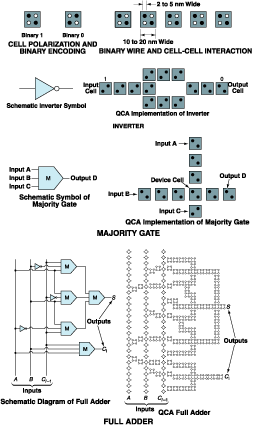
Again, for reasons too complex to describe here, in order to ensure accuracy and timeliness of the output of a QCA array, it is necessary to resort to an adiabatic switching scheme in which the QCA array is divided into subarrays, each controlled by a different phase of a multiphase clock signal. In this scheme, each subarray is given time to perform its computation, then its state is frozen by raising its interdot potential barriers and its output is fed as the input to the successor subarray. The successor subarray is kept in an unpolarized state so it does not influence the calculation of preceding subarray. Such a clocking scheme is consistent with pipeline computation in the sense that each different subarray can perform a different part of an overall computation. In other words, QCA arrays are inherently suitable for pipeline and, moreover, systolic computations. This sequential or pipeline aspect of QCA would be utilized in the proposed bit-serial adders.

A bit-serial adder would perform the addition operation on two sequences of input bits (ai and bi for i = 1 to n) to generate a sequence of sum bits (Si for i = 1 to n + 1). To be able to perform the addition operation, the adder would have to be capable of storing the intermediate carry bits. A feedback loop could be used to effect such storage.
Figure 2 schematically depicts a bit-serial adder containing three majority gates and two inverter gates. This circuit could, optionally, be used as a full adder, in which role it would be more efficient, relative to the adder of Figure 1, in that it would contain fewer gates. The main advantage of the circuit of Figure 2 is that by use of suitable multiphase clocking, one could cause part of the circuit to act as a feedback loop for temporary storage of intermediate carry bits, thus enabling bit-serial addition. The ability of this circuit to perform bit-serial addition has been verified by computer simulation. However, several obstacles to practical implementation of a QCA-based bit-serial adder that could function without error at room temperature must still be overcome.
This work was done by Amir Fijany, Nikzad Toomarian, Katayoon Modarress, and Matthew Spotnitz of Caltech for NASA's Jet Propulsion Laboratory. For further information, access the Technical Support Package (TSP) free on-line at www.techbriefs.com/tsp under the Computers/Electronics category. NPO-20869.
This Brief includes a Technical Support Package (TSP).
Bit-Serial Adder Based on Quantum Dots
(reference NPO-20869) is currently available for download from the TSP library.
Don't have an account?
Overview
The document is a technical support package from NASA's Jet Propulsion Laboratory (JPL) detailing a bit-serial adder based on quantum-dot cellular automata (QCA). It highlights the limitations of traditional very-large-scale integrated (VLSI) circuitry, particularly the requirement that signal paths must not cross in the same plane to avoid interference. In contrast, QCA technology allows for signal paths to cross without adverse effects, enabling the design of more compact and efficient circuits.
The core concept of QCA involves cells made up of four quantum dots arranged in a square, with two mobile electrons that can tunnel between neighboring dots. The arrangement of these electrons, influenced by Coulomb repulsion, determines the cell's polarization state, which encodes binary information. This unique property allows for the construction of universal logic gates and binary wires by arranging multiple QCA cells in specific patterns.
The document outlines the design and operation of a proposed bit-serial adder, which incorporates a feedback loop for temporary storage of carry bits. This design aims to leverage the advantages of QCA to create a more efficient computational architecture compared to traditional VLSI circuits. The potential applications of this technology could lead to significant advancements in computing power and efficiency, particularly in fields requiring complex interconnection schemes.
The research is presented as part of a broader initiative to explore the capabilities of quantum computing and its implications for future technology. The document emphasizes that while the work is sponsored by NASA, it does not imply any endorsement of specific commercial products or services.
Overall, the technical support package serves as a comprehensive overview of the innovative approach to computing using quantum-dot cellular automata, showcasing the potential for developing advanced, compact, and efficient electronic systems that could revolutionize the field of computing. The findings and designs presented in this document are positioned at the forefront of research in quantum computing and integrated circuit design, offering insights into the future of technology.