The synthesis of some fuzzy-logic circuits by use of evolvable hardware (EHW) has been demonstrated in an investigation of EHW as a means of auto- mated synthesis of computational-intelligence circuitry in general. This investigation is, in turn, part of continuing research on the broader topic of EHW as the basis of a general method of automated design and/or automated direct synthesis of electronic circuits that can perform acceptably close approximations of any desired analog and/or digital functions.
The basic concepts and some specific implementations of EHW were described in several previous NASA Tech Briefs articles, namely: “Reconfigurable Arrays of Transistors for Evolvable Hardware” (NPO-20078), Vol. 25, No. 2 (February 2001), page 36; “Evolutionary Automated Synthesis of Electronic Circuits” (NPO-20535), Vol. 26, No. 7 (July 2002), page 33; “Designing Reconfigurable Antennas Through Hardware Evolution” (NPO-20666), Vol. 26, No. 7 (July 2002), page 34; “‘Morphing’ in Evolutionary Synthesis of Electronic Circuits” (NPO-20837), Vol. 26, No. 8 (August 2002), page 31; and “Mixtrinsic Evolutionary Synthesis of Electronic Circuits” (NPO-20773), Vol. 26, No. 8 (August 2002), page 32.
To recapitulate from the cited prior articles: “Evolution” and “evolvable” as applied to EHW are meant in a quasi-genetic sense, referring to the construction and testing of a sequence of populations of circuits that function as incrementally better solutions of a given design problem. Evolution is effected through the selective, repetitive connection and/or disconnection of transistors, amplifiers, inverters, and/or other circuit building blocks. The evolution is guided by a search-and-optimization algorithm (in particular, a genetic algorithm) that operates in the space of possible circuits to find a circuit that exhibits the desired behavior. If evolved circuits are tested by mathematical modeling (that is, computational simulation) only, the evolution is said to be extrinsic; if they are tested in real hardware, the evolution is said to be intrinsic; if they are tested in random sequences of computational simulation and real hardware, the evolution is said to be mixtrinsic.
For the synthesis of fuzzy-logic circuitry following the present approach, the hardware portion of an EHW system is a field-programmable transistor array (FPTA) — a very-large-scale integrated (VLSI) circuit that contains electronically reconfigurable cellular arrays of transistors (optionally also including resistors and capacitors). “Electronically reconfigurable” signifies that the electrical connections among elements of an array are made and broken by use of transistor switches that are commanded to open or close, respectively, by control bit strings generated by an evolutionary algorithm. EHW is especially attractive as a potential means of synthesizing combinatorial fuzzy-logic circuits because it is very difficult to synthesize such circuits by conventional design methods. When fuzzy logic is implemented in electronically reconfigurable circuitry, there is an additional advantage of flexibility to change the circuitry in the event that a need for changed fuzzy logic arises during operation.
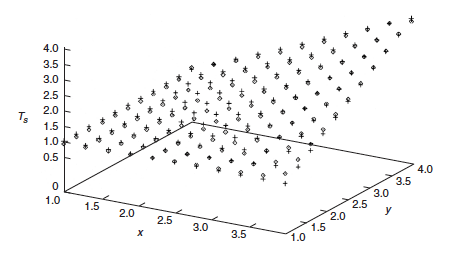
The fuzzy-logic operators considered thus far in the investigation are of a subtype of the type known in the art as triangular norms and conorms. The triangular norms and conorms are used in fuzzy logic to represent conjunctions (roughly the equivalent of AND operators) and disjunctions (roughly the equivalent of OR operators). A triangular norm or conorm of the particular subtype considered is a function of two input signals (x and y) and a parameter (s). In the case s = 0, this particular triangular norm or conorm is a minimum or maximum function (equal to x or y, which is smaller or larger, respectively); in cases of s ≠ 0, this triangular norm and conorm are more complex functions of x and y. The figure depicts the response of a circuit that was evolved directly in hardware on a FPTA chip for the case s = 100, for which the triangular norm is given by 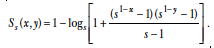
This work was done by Adrian Stoica of Caltech for NASA’s Jet Propulsion Laboratory.
Refer to NPO-21095.
This Brief includes a Technical Support Package (TSP).
Synthesis of Fuzzy-Logic Circuits in Evolvable Hardware
(reference NPO-21095) is currently available for download from the TSP library.
Don't have an account?
Overview
The document titled "Synthesis of Fuzzy-Logic Circuits in Evolvable Hardware" presents research conducted by Adrian Stoica at NASA's Jet Propulsion Laboratory (JPL) on the use of evolvable hardware (EHW) for the automated synthesis of fuzzy-logic circuits. The investigation focuses on the application of fuzzy logic, which employs triangular norms and conorms to represent logical operations such as conjunctions (AND) and disjunctions (OR). These operations are essential in computational intelligence and are implemented through complex functions of input signals.
EHW is described as a quasi-genetic approach to circuit design, where populations of circuits are constructed and tested iteratively to find optimal solutions for specific design problems. The evolution of these circuits is guided by a search-and-optimization algorithm, particularly a genetic algorithm, which explores the space of possible circuit configurations. The document distinguishes between different types of evolution: extrinsic (tested through computational simulation), intrinsic (tested in real hardware), and mixtrinsic (a combination of both).
The hardware utilized in this research is a field-programmable transistor array (FPTA), a type of very-large-scale integrated (VLSI) circuit that allows for electronically reconfigurable cellular arrays of transistors. This flexibility is a significant advantage, as it enables the modification of fuzzy logic circuitry in response to changing operational needs.
The synthesis of fuzzy-logic circuits through EHW is highlighted as a promising method for overcoming the challenges associated with conventional design techniques. The document references previous NASA Tech Briefs that outline foundational concepts and specific implementations of EHW, emphasizing its potential for automated design and synthesis of electronic circuits capable of approximating desired analog and digital functions.
Overall, the research underscores the innovative use of EHW in the field of computational intelligence, showcasing its ability to evolve circuits that can perform complex logical operations effectively. The findings contribute to the broader understanding of automated circuit design and the future of reconfigurable hardware in various applications.