Efforts are under way to apply the concept of evolvable hardware (EHW) to compensate for variations, with temperature, in the operational characteristics of electronic circuits. To maintain the required functionality of a given circuit at a temperature above or below the nominal operating temperature for which the circuit was originally designed, a new circuit would be evolved; moreover, to obtain the required functionality over a very wide temperature range, there would be evolved a number of circuits, each of which would satisfy the performance requirements over a small part of the total temperature range.
The basic concepts and some specific implementations of EHW were described in a number of previous NASA Tech Briefs articles, namely, "Reconfigurable Arrays of Transistors for Evolvable Hardware" (NPO-20078), Vol. 25, No. 2 (February 2001), page 36; "Evolutionary Automated Synthesis of Electronic Circuits" (NPO-20535), Vol. 26, No. 7 (July 2002), page 37; "Designing Reconfigurable Antennas Through Hardware Evolution" (NPO-20666), Vol. 26, No. 7 (July 2002), page 38; "'Morphing' in Evolutionary Synthesis of Electronic Circuits" (NPO-20837), Vol. 26, No. 8 (August 2002), page 31;"Mixtrinsic Evolutionary Synthesis of Electronic Circuits" (NPO-20773) Vol. 26, No. 8 (August 2002), page 32; and "Synthesis of Fuzzy-Logic Circuits in Evolvable Hardware" (NPO-21095) Vol. 26, No. 11 (November 2002), page 38.
To recapitulate from the cited prior articles: EHW is characterized as evolutionary in a quasi-genetic sense. The essence of EHW is to construct and test a sequence of populations of circuits that function as incrementally better solutions of a given design problem through the selective, repetitive connection and/or disconnection of capacitors, transistors, amplifiers, inverters, and/or other circuit building blocks. The connection and disconnection can be effected by use of field programmable transistor arrays (FPTAs). The evolution is guided by a search and optimization algorithm (in particular, a genetic algorithm) that operates in the space of possible circuits to find a circuit that exhibits an acceptably close approximation of the desired functionality. The evolved circuits can be tested by mathematical modeling (that is, computational simulation) only, tested in real hardware, or tested in combinations of computational simulation and real hardware.
In principle, the application of the EHW concept to temperature compensation could be straightforward: If, for example, a change in temperature were to change the functionality of an EHW circuit such as to cause a measure of the error in the functionality to exceed a specified threshold, then the process of evolutionary automated synthesis could be resumed, possibly taking account of previous circuit configurations in the population. The evolutionary process would be stopped once an evolved circuit performed with an error below the threshold.
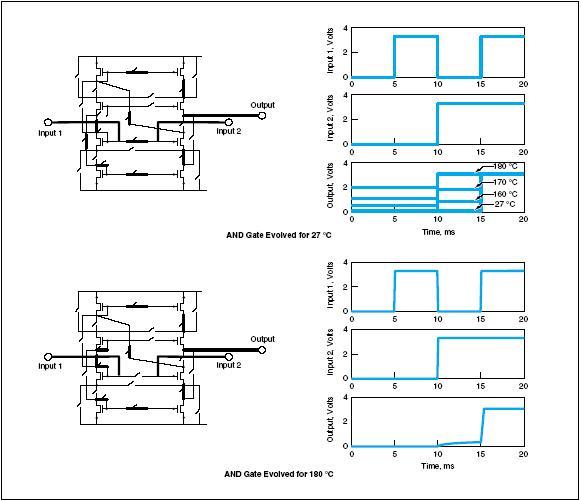
The application of the EHW concept to temperature compensation has been demonstrated in computational simulations and in experiments on real FPTAs at controlled temperatures. In one set of computational simulations, an AND gate was evolved to function at a temperature of 27ºC. As shown in the upper part of the figure, its response deteriorated as the temperature was increased to 180ºC. The evolutionary process was then begun toward a new version of the circuit in the hope of restoring the desired AND-gate function at 180ºC. As shown in the lower part of the figure, the evolution yielded a close approximation of the desired result.
This work was done by Adrian Stoica of Caltech for NASA's Jet Propulsion Laboratory. For further information, access the Technical Support Package (TSP) free on-line at www.techbriefs.com/tsp under the Electronics/Computers category. NPO-21146
This Brief includes a Technical Support Package (TSP).
EHW Approach to Temperature Compensation of Electronics
(reference NPO-21146) is currently available for download from the TSP library.
Don't have an account?
Overview
The document discusses a novel approach to enhancing the functionality and reliability of electronics in extreme temperature environments, particularly for NASA missions. It focuses on the use of evolvable hardware (EHW) technology, which allows for adaptive in-situ circuit redesign and reconfiguration during operation. This is crucial for applications in space exploration, where electronics must function under extreme conditions, such as temperatures below -220°C or above 470°C.
Current technologies primarily focus on component-level robustness and hardening, which provide limited lifetime in harsh environments. The proposed EHW approach aims to overcome these limitations by enabling circuits to evolve and adapt to changing conditions. The process involves constructing and testing populations of circuits that improve incrementally through selective connection and disconnection of various circuit components, guided by genetic algorithms. This evolutionary process can be initiated when a circuit's functionality degrades due to temperature changes, allowing for the development of new configurations that restore performance.
The document outlines experiments conducted with a prototype chip that demonstrated the ability to recover functionality at temperatures as high as 250°C. The experiments involved implementing an initial design at room temperature, exposing the chip to extreme temperatures, and then applying evolutionary algorithms to generate new circuit solutions that could recover the desired functionality.
The authors emphasize that this adaptive reconfiguration capability not only complements advancements in materials and devices but also significantly enhances the mission capabilities of electronics in extreme environments. The research highlights the potential for EHW to synthesize circuits that can operate accurately at high temperatures, where conventional designs fail.
In summary, the document presents a forward-thinking solution to the challenges posed by extreme temperature variations in electronic systems. By leveraging evolvable hardware technology, the research aims to create more resilient and adaptable electronic circuits, ultimately improving the reliability and longevity of devices used in space exploration and other demanding applications. This innovative approach could pave the way for future missions that require electronics to perform reliably in harsh and variable conditions.