A command interface application-specific integrated circuit (ASIC) and an analog interface ASIC have been developed as a chip set for remote actuation and monitoring of a collection of switches, which can be used to control generic loads, pyrotechnic devices, and valves in a high-radiation environment. The command interface ASIC (CIA) can be used alone or in combination with the analog interface ASIC (AIA). Designed primarily for incorporation into spacecraft control systems, they are also suitable for use in high-radiation terrestrial environments (e.g., in nuclear power plants and facilities that process radioactive materials).
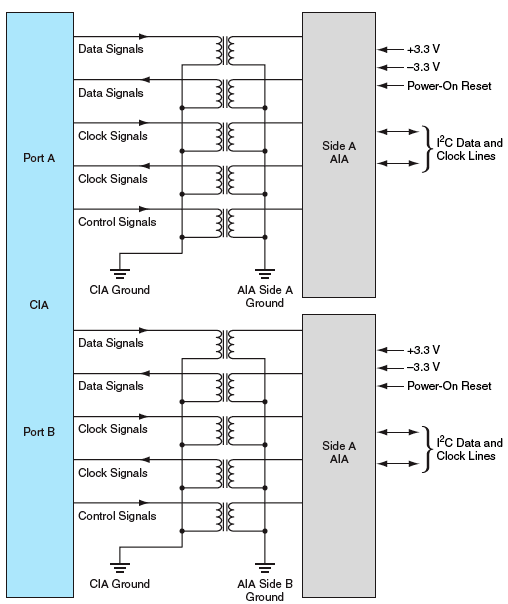
The AIA is a mixed-signal ASIC that includes the analog circuitry needed to connect the CIA to a custom higher-powered version of the I2C bus. The higher-powered version is designed to enable operation with bus cables longer than those contemplated in the I2C standard. If there are multiple higher-power I2C-like buses, then there must an AIA between the CIA and each such bus. The AIA includes two identical interface blocks: one for the side-A I2C clock and data buses and the other for the side B buses. All the AIAs on each side are powered from a common power converter module (PCM). Sides A and B of the I2C buses are electrically isolated from each other (see figure). They are also isolated from the CIA by use of transformer coupling of signals between the AIA blocks and the CIA.
This work was done by Baldes Ruiz, Burton Jaffe, Gary Burke, Gerald Lung, Gregory Pixler, Joe Plummer, Sunant Katanyoutanant, and William Whitaker of Caltech for NASA's Jet Propulsion Laboratory. For further information, access the Technical Support Package (TSP) free on-line at www.techbriefs.com/tsp under the Computers/Electronics category. In accordance with Public Law 96-517, the contractor has elected to retain title to this invention. Inquiries concerning rights for its commercial use should be addressed to: Intellectual Assets Office Refer to NPO-30275, volume and number of this NASA Tech Briefs issue, and the page number.
JPL
Mail Stop 202-233
4800 Oak Grove Drive
Pasadena, CA 91109
(818) 354-2240
E-mail:
This Brief includes a Technical Support Package (TSP).
Command Interface ASIC-Analog Interface ASIC Chip Set
(reference NPO-30275) is currently available for download from the TSP library.
Don't have an account?
Overview
The document outlines the development of the Command Interface ASIC (CIA) and Analog Interface ASIC (AIA) chip-set, created under the sponsorship of NASA and developed at the Jet Propulsion Laboratory (JPL). This innovative chip-set is designed to enhance the control and monitoring of power systems in spacecraft, particularly in high-radiation environments.
The CIA is an embedded microcontroller that integrates fault-tolerant switch control and monitoring circuitry. It is capable of interfacing with the industry-standard Phillips I2C bus, as well as a higher power version of this bus through the AIA. This integration allows for a significant reduction in the complexity and number of custom electronic packages previously required for various functions such as power cycling, firing pyrotechnics, and actuating valves. By consolidating these functions into a single chip-set, the design minimizes demands on flight computers and associated software, ultimately reducing costs and development time.
The document highlights the novelty of the CIA-AIA chip-set, emphasizing its unique capability to operate in high-radiation environments, which is critical for space applications. The chip-set is designed to withstand radiation levels that could cause single-event upsets, ensuring robust performance in space missions. This capability allows for the use of commercial components for prototyping, which streamlines the development process and avoids the need for expensive custom components.
The technical disclosure section details the motivation behind the development of the chip-set, which arose from the need to simplify the electronic systems used in JPL spacecraft. Historically, different electronic packages were required for various functions, leading to increased complexity, design time, and costs. The CIA-AIA chip-set addresses these issues by providing a unified solution that meets multiple operational needs.
Additionally, the document includes information about the fault protection and timing logic integrated within the CIA, which includes a watchdog timer and mechanisms for responding to under-voltage and power-on reset conditions. The chip-set's design also allows for flexible operating frequencies, which can be adjusted in-flight to conserve power.
In summary, the CIA-AIA chip-set represents a significant advancement in spacecraft electronics, offering a reliable, cost-effective solution for controlling and monitoring power systems in challenging environments, thereby supporting NASA's ongoing space exploration efforts.