

An inexpensive wall clock has been devised for displaying solar time or sidereal time as it would be perceived on a planet other than the Earth, or for displaying sidereal time on the Earth. The concept of a wall clock synchronized to a period other than the terrestrial mean solar day is not new in itself. What is new here is that the clock is realized through a relatively simple electronic modification of a common battery-powered, quartz-crystal-oscillator- driven wall clock (which, as unmodified, displays terrestrial mean solar time).
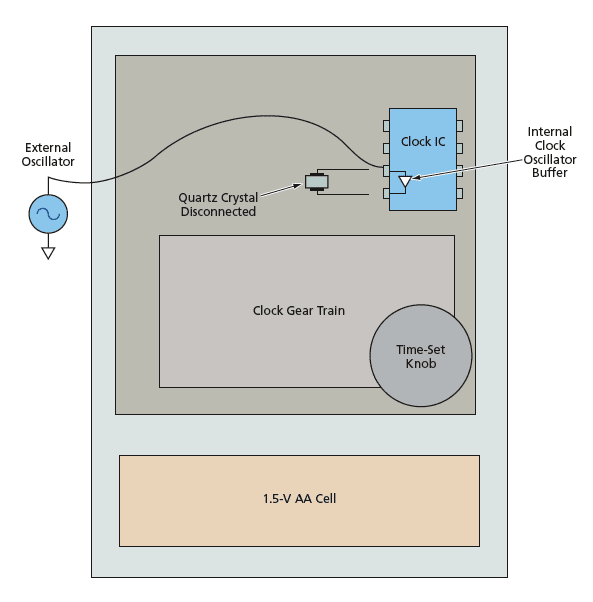
The essence of the modification is to shut off the internal oscillator of the clock and replace the internal-oscillator output signal with a signal of the required frequency generated by an external oscillator. The unmodified clock electronic circuitry includes a quartz crystal connected to an integrated circuit (IC) that includes, among other parts, a buffer amplifier that conditions the oscillator output. The modification is effected by removing the quartz crystal and connecting the output terminal of the external oscillator, via a capacitor, to the input terminal of the buffer amplifier (see figure).
The frequency and amplitude of the external-oscillator signal must be chosen in accordance with the IC design as well as the desired clock speed. Typically, the required amplitude is 0.5 V peak-to-peak and the frequency required for two complete revolutions of the hour hand (two 12-hour cycles) spanning a terrestrial mean solar day is 215 = 32,768 Hz. Examples of other clock cycles and frequencies based on this typical design include the following:
- For one complete revolution of the hour hand (one 24-hour cycle) during a terrestrial mean solar day, the required frequency is 214 = 16,384 Hz.
- For two complete revolutions of the hour hand (two 12-"hour" cycles) during a terrestrial sidereal day, the required frequency is 32,859.27577 Hz.
- For one complete revolution of the hour hand (one 24-"hour" cycle) during a terrestrial sidereal day, the required frequency is 16,429.63788 Hz.
- For two complete revolutions of the hour hand (two 12-"hour" cycles) during a Martian mean solar day, the required frequency is 31,947.1361 Hz.
- For one complete revolution of the hour hand (one 24-"hour" cycle) during a Martial sidereal day, the required frequency is 15,973.568 Hz.
It is worthwhile to note that for the 24- hour or for any of the 24-"hour" clock speeds, the minute hand would complete a revolution in 2 hours or "hours". Therefore, it could be desirable to remove the minute hand to prevent confusion. In addition, in that case, the 12-hour faceplate must be replaced by a 24-hour faceplate.
It is also worthwhile to note that the precision of the clock display depends on the precision of the external oscillator, which can be cheap or expensive, as needed to obtain the precision required for a specific application. For example, the external oscillator could be a battery-powered, fixed-frequency quartz oscillator; a commercially available programmable integrated- circuit frequency synthesizer; or a programmable frequency synthesizer locked to highly stable reference oscillator (e.g., a hydrogen maser).
This work was done by James Lux of Caltech for NASA's Jet Propulsion Laboratory.
This Brief includes a Technical Support Package (TSP).
Inexpensive Clock for Displaying Planetary or Sidereal Time
(reference NPO-40845) is currently available for download from the TSP library.
Don't have an account?
Overview
The document outlines a technical support package from NASA's Jet Propulsion Laboratory (JPL) detailing an innovative solution for displaying planetary and sidereal time using a modified quartz wall clock. The primary motivation for this development stems from the lack of readily available analog clocks that can represent time bases other than Earth. While digital displays exist, they tend to be expensive and less intuitive for users who prefer a traditional clock face.
The proposed solution involves modifying a standard battery-powered quartz clock movement to operate using an external frequency source instead of its internal quartz crystal oscillator. This modification allows the clock to be adjusted to run at various frequencies, enabling it to accurately display time for different celestial bodies. For instance, to display Earth time, the external signal must be set to 32.768 kHz for standard clock speed, while for Mars, which has a day (sol) approximately 37 minutes longer than an Earth day, the frequency must be adjusted to about 97.495% of the Earth frequency. This results in settings of approximately 31.947 kHz for two revolutions per sol or 15.973 kHz for one revolution per sol.
The document emphasizes the advantages of this approach, highlighting that the clock can be battery-powered, allowing it to function independently of external references. This feature is particularly beneficial for use in remote locations or in space missions where traditional timekeeping methods may not be feasible.
Additionally, the design allows for easy adaptation to display any planetary local time, making it versatile for various scientific applications. Users can also modify the clock's faceplate to reflect a 24-hour format suitable for Mars timekeeping, enhancing its usability.
Overall, this technical disclosure presents a cost-effective and intuitive method for displaying time on other planets, addressing a significant gap in available timekeeping devices. The innovation not only serves practical purposes for scientific research but also provides a familiar interface for users, making it easier to understand and visualize time in a planetary context. The document concludes by inviting further inquiries and collaboration through NASA's Innovative Partnerships Program.











