The figure shows one of four solid-state power amplifiers, each capable of generating an output power ≥240 mW over one of four overlapping frequency bands from 71 to 106 GHz. (The bands are 71 to 84, 80 to 92, 88 to 99, and 89 to 106 GHz.) The amplifiers are designed for optimum performance at a temperature of 130 K. These amplifiers were developed specifically for incorporation into frequency-multiplier chains in local oscillators in a low-noise, far-infrared receiving instrument to be launched into outer space to make astrophysical observations. The designs of these amplifiers may also be of interest to designers and manufacturers of terrestrial W-band communication and radar systems.
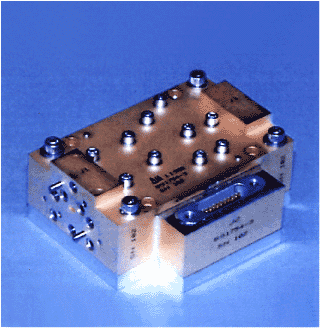
This Photograph Shows One of the Amplifiers described in the text. A WR-10 waveguide input port is on the left end. The output port is on the right end, facing away. DC input and sensing conductors enter the package via a 21-pin connector. (Module dimensions: 20 ´ 49 ´ 60 mm.)
This work was done by Todd Gaier, Lorene Samoska, Mary Wells, Robert Ferber, John Pearson, April Campbell, and Alejandro Peralta of Caltech for NASA's Jet Propulsion Laboratory and Gerald Swift, Paul Yocum, and Yun Chung of TRW, Inc. For further information, access the Technical Support Package (TSP) free on-line at www.nasatech.com/tsp under the Computers/Electronics category.
NPO-30724
This Brief includes a Technical Support Package (TSP).
High-Performance Solid-State W-Band Power Amplifiers
(reference NPO-30724) is currently available for download from the TSP library.
Don't have an account?
Overview
The document outlines the development of W-Band power amplifiers for the Local Oscillator (LO) chains of the Herschel Heterodyne Instrument for Far Infrared (HIFI), a key component of the Herschel Space Observatory, launched by the European Space Agency in 2007. The HIFI instrument is designed to operate in the frequency range of 480 GHz to 1900 GHz, utilizing low noise superheterodyne receivers with superconducting Hot Electron Bolometers (HEB) or Semiconductor-Insulator-Semiconductor (SIS) mixers, functioning at approximately 2 Kelvin.
The primary goal of the HIFI program was to create a set of power amplifier chips capable of delivering stable, high-efficiency output across several frequency bands (71-113 GHz) with a target power output of 240 mW. Prior to this initiative, only a few narrow-band power amplifier chips existed, which limited the capabilities of high-frequency applications.
The document details the technical challenges faced during the development of these amplifiers, including the design of connectors and packages to fit constrained spaces, impedance matching across frequency bands, and the suppression of unwanted oscillations. Each amplifier consists of six high-electron-mobility transistor (HEMT) GaAs monolithic microwave integrated circuit (MMIC) chips, microstrip cavities, and other components housed in a silicon-aluminum alloy package, chosen for its thermal conductivity, low mass, and low thermal expansion properties.
The development team, comprising members from Caltech and TRW, addressed various issues such as power output control, leveling across bands, and the design of microstrip signal-power splitters and combiners. The amplifiers were meticulously designed to ensure stable operation at cryogenic temperatures, which is essential for the HIFI instrument's performance.
The document emphasizes the significance of these amplifiers in enabling the HIFI instrument to conduct astrophysical observations, particularly in star-forming regions of the Milky Way Galaxy. The successful development of these W-Band amplifiers represents a significant advancement in the field of radio frequency technology, with potential implications for both space exploration and terrestrial applications in communication and radar systems.
Overall, the document serves as a comprehensive summary of the technical innovations and collaborative efforts that led to the successful realization of the HIFI power amplifiers, highlighting their importance in advancing our understanding of the universe.