

The shapes of waveforms generated by commercially available analytical separation devices, such as some types of mass spectrometers and differential mobility spectrometers are, in general, inadequate and result in resolution degradation in output spectra. A waveform generator was designed that would be able to circumvent these shortcomings. It is capable of generating an asymmetric waveform, having a peak amplitude as large as 2 kV and frequency of several megahertz, which can be applied to a capacitive load. In the original intended application, the capacitive load would consist of the drift plates in a differential-mobility spectrometer. The main advantage to be gained by developing the proposed generator is that the shape of the waveform is made nearly optimum for various analytical devices requiring asymmetric-waveform such as differential-mobility spectrometers. In addition, this waveform generator could easily be adjusted to modify the waveform in accordance with changed operational requirements for differential-mobility spectrometers.
The capacitive nature of the load is an important consideration in the design of the proposed waveform generator. For example, the design provision for shaping the output waveform is based partly on the principle that (1) the potential (V) on a capacitor is given by V = q/C, where C is the capacitance and q is the charge stored in the capacitor; and, hence (2) the rate of increase or decrease of the potential is similarly proportional to the charging or discharging current.
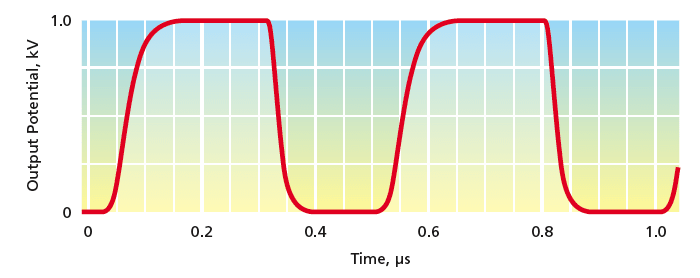
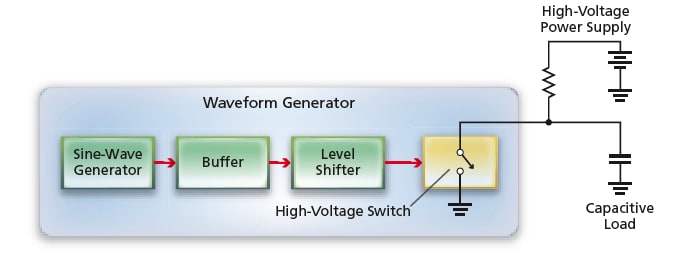
The proposed waveform generator would comprise four functional blocks: a sine-wave generator, a buffer, a voltage shifter, and a high-voltage switch (see Figure 1). The sine-wave generator would include a pair of operational amplifiers in a feedback configuration, the parameters of which would be chosen to obtain a sinusoidal timing signal of the desired frequency. The buffer would introduce a slight delay (≈20 ns) but would otherwise leave the fundamental timing signal unchanged. The buffered timing signal would be fed as input to the level shifter. The output of the level shifter would serve as a timing and control signal for the high-voltage switch, causing the switch to alternately be (1) opened, allowing the capacitive load to be charged from a high-voltage DC power supply; then (2) closed to discharge the capacitive load to ground. Hence, the output waveform would closely approximate a series of exponential charging and discharging curves (see Figure 2).
This work was done by Luther W. Beegle, Tuan A. Duong, Vu A. Duong, and Isik Kanik of Caltech for NASA's Jet Propulsion Laboratory.
NPO-45665
This Brief includes a Technical Support Package (TSP).
High-Voltage, Asymmetric-Waveform Generator
(reference NPO-45665) is currently available for download from the TSP library.
Don't have an account?
Overview
The document is a Technical Support Package from NASA's Jet Propulsion Laboratory (JPL) detailing the High-Voltage, Asymmetric-Waveform Generator, referenced as NPO-45665 in NASA Tech Briefs. It serves to disseminate information about aerospace-related technological advancements that have potential applications beyond their original context.
The primary focus of the document is on a high-voltage pulse circuit designed to generate asymmetric waveforms, which are crucial for various applications in aerospace and other fields. The circuit operates at 1 kV and 2 MHz, showcasing its capability to handle high voltage and speed. The document includes circuit diagrams and simulation results that illustrate the performance of the circuit components, such as voltage level shifters, buffers, and high-voltage switches.
Key figures in the document provide visual representations of the circuit's operation. For instance, Figure 2 shows the simulation results of the high-voltage pulse design over a time span of 10 microseconds, detailing the voltage levels at different points in the circuit. Figure 3 further illustrates the output characteristics, including a close-up of the voltage level shifter output and the asymmetrical pulse generated.
The document emphasizes the importance of these high-voltage circuits in various applications, including their potential use in space exploration and other high-tech industries. It highlights the building blocks of the circuit, which include components like capacitors, resistors, and operational amplifiers, all of which contribute to the circuit's functionality and performance.
Additionally, the document contains a notice regarding the proprietary nature of the information, indicating that it may be subject to export control regulations. It also provides contact information for further inquiries related to research and technology in this area, encouraging collaboration and innovation.
Overall, this Technical Support Package serves as a comprehensive resource for understanding the design, simulation, and potential applications of high-voltage asymmetric waveform generators, reflecting NASA's commitment to advancing technology for broader scientific and commercial use.











