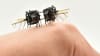
A waveguide structure for combining the outputs of four amplifiers operating at 35 GHz (Ka band) is based on a similar prior structure used in the X band. The structure is designed to function with low combining loss and low total reflected power at a center frequency of 35 GHz with a 160 MHz bandwidth.
The structure (see figure) comprises mainly a junction of five rectangular waveguides in a radial waveguide. The outputs of the four amplifiers can be coupled in through any four of the five waveguide ports. Provided that these four signals are properly phased, they combine and come out through the fifth waveguide port.
This work was done by Raul Perez and Samuel Li of Caltech for NASA's Jet Propulsion Laboratory.
This Brief includes a Technical Support Package (TSP).
Four-Way Ka-Band Power Combiner
(reference NPO-41291) is currently available for download from the TSP library.
Don't have an account?
Overview
The document discusses the development and implementation of a Four-Way Ka-Band Power Combiner, designated as NPO-41291, by NASA's Jet Propulsion Laboratory (JPL). This technology represents a significant advancement in radar instrumentation, particularly for high-power applications at Ka-band frequencies, specifically around 35 GHz.
The primary goal of the project was to generate a 10 kW signal at Ka-band by combining four individual power sources, each capable of delivering 2.5 kW. The design addresses the challenges associated with power combining, such as minimizing combining loss and total reflected power, which is defined as the reverse power present in the inputs when all inputs are powered. The innovative solution involves a junction of five rectangular waveguides arranged in a radial configuration, allowing input signals from any four ports to combine effectively and exit through the remaining port.
The document highlights that while similar technologies have been implemented at X-band frequencies, this particular design successfully adapts the concept for Ka-band applications. The design process included the use of High-Frequency Structure Simulator (HFSS) software for modeling, and a prototype was built and tested using two-port network analyzer measurements to validate its performance.
The concept for the power combiner is based on previous research, specifically an IEEE paper that discusses high-power four-way dividers/combiners, although that work was focused on millimeter wave frequencies and X-band applications. The successful adaptation to Ka-band signifies a notable achievement in radar technology, with potential implications for various aerospace-related developments.
The document also serves as a technical support package under NASA's Commercial Technology Program, aimed at disseminating aerospace-related innovations with broader technological, scientific, or commercial applications. It emphasizes the importance of compliance with U.S. export regulations and provides contact information for further inquiries related to research and technology in this area.
Overall, the Four-Way Ka-Band Power Combiner represents a significant step forward in high-power radar technology, showcasing NASA's commitment to advancing aerospace capabilities and fostering innovative partnerships for future developments.