

A monolithic microwave integrated circuit (MMIC) has been designed to function as a low-power-consumption, low-noise amplifier (LNA) at frequencies from about 65 to about 110 GHz. This MMIC incorporates TRW's state-of-the-art, InP-based, high-electron-mobility transistors (HEMTs) coupled with coplanar- waveguide (CPW) transmission lines, thin-film resistors, and thin-film capacitors. The MMIC is mounted in a waveguide module with CPW-to-waveguide transitions of the probe type (see figure).
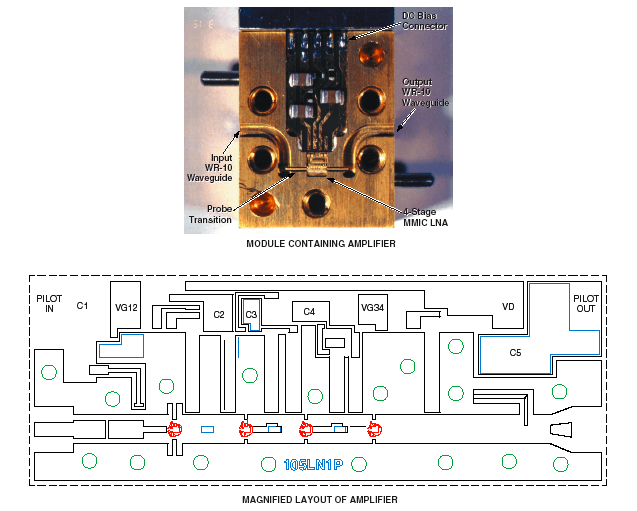
The MMIC is designed to operate in the presence of cooling by a suitable cryogenic apparatus. Seventeen waveguide modules containing copies of the MMIC were tested for noise temperature by use of a variable-temperature waveguide with a 20-dB attenuator and a precise diode temperature sensor. The range of noise temperatures over the 85-to-115-GHz frequency range was found to be 30 to 107 K at an operating temperature of 24 K. The noise at room operating temperature was found to range from 250 to 470 K. In other tests, the MMICs were found to be capable of producing 20 dB of gain while consuming as little as 1.4 mW of dc power.
This work was done by Todd Gaier and Sander Weinreb of Caltech, Neal Erickson of the University of Massachusetts, and Richard Lai of TRW for NASA's Jet Propulsion Laboratory. For further information, access the Technical Support Package (TSP) free on-line at www.nasatech.com/tsp under the Electronic Components and Systems category.
NPO-20752
This Brief includes a Technical Support Package (TSP).
InP HEMT MMIC Low-Noise Amplifier for 65 to 110 GHz
(reference NPO-20752) is currently available for download from the TSP library.
Don't have an account?
Overview
The document presents a technical overview of a monolithic microwave integrated circuit (MMIC) designed as a low-noise amplifier (LNA) for frequencies ranging from 65 to 110 GHz. Developed by a team from NASA's Jet Propulsion Laboratory, including Neal Erickson, Richard Lai, Sander Weinreb, and Todd Gaier, this MMIC utilizes state-of-the-art InP-based high-electron-mobility transistors (HEMTs) and incorporates coplanar-waveguide (CPW) transmission lines, thin-film resistors, and capacitors.
Key features of the MMIC include its low power consumption and low noise characteristics, making it suitable for various applications, particularly in radiometry where precise measurements are critical. The MMIC operates effectively in both cryogenic (24 K) and room temperature (300 K) environments, with noise temperatures measured between 30 to 107 K at cryogenic temperatures and 250 to 470 K at room temperature. The device is capable of delivering a gain of 20 dB while consuming as little as 1.4 mW of DC power.
An innovative aspect of the design is the inclusion of a pilot signal path, which operates at a typical frequency of 500 MHz. This pilot signal is routed through the same transistors used for amplifying the millimeter-wave signal, allowing for real-time monitoring of gain fluctuations without significant interaction with the primary signal. This feature is particularly beneficial in applications where maintaining consistent gain is essential.
The MMIC is housed in a waveguide module that facilitates CPW-to-waveguide transitions, ensuring efficient signal transmission. The document also references a publication accepted for the IEEE MTT Symposium, which details the performance metrics and modeling of the device.
Overall, this MMIC represents a significant advancement in low-noise amplification technology, combining high performance with low power requirements, making it a valuable tool for scientific and engineering applications in the millimeter-wave frequency range. The work is part of ongoing research and development efforts at NASA, aimed at enhancing the capabilities of space and terrestrial communication systems.











