A monolithic microwave integrated circuit (MMIC) that includes a high-electron-mobility transistor (HEMT) has been developed as a prototype of improved frequency doublers for generating signals at frequencies >100 GHz. Signal sources that operate in this frequency range are needed for a variety of applications, notably including general radiometry and, more specifically, radiometric remote sensing of the atmosphere.
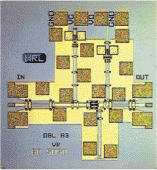
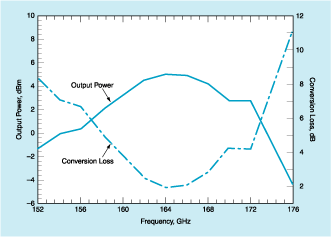
At an input power of 7 mW, the output power and conversion loss at an output frequency of 164 GHz were found to be 5 dBm (≈3.2 mW) and 2 dB, respectively, with a 3-dB output-power bandwidth of 14 GHz. This is the best performance reported to date for an MMIC HEMT frequency doubler above 100 GHz.
This work was done by Lorene Samoska of NASA's Jet Propulsion Laboratory, Vesna Radisic, Miro Micovic, Ming Hu, Paul Janke, Catherine Ngo, and Loi Nguyen of HRL Laboratories, LLC, and Matthew Morgan of Caltech. For further information, access the Technical Support Package (TSP) free on-line at www.techbriefs.com/tsp under the Computers/Electronics category. NPO-21197
This Brief includes a Technical Support Package (TSP).
164-GHz MMIC HEMT Frequency Doubler
(reference NPO-21197) is currently available for download from the TSP library.
Don't have an account?
Overview
The document discusses the development of a 164 GHz monolithic microwave integrated circuit (MMIC) frequency doubler utilizing a high-electron-mobility transistor (HEMT). This innovative technology was created by a team from NASA’s Jet Propulsion Laboratory and HRL Laboratories, LLC, and aims to improve signal generation for applications requiring frequencies above 100 GHz, such as radiometric remote sensing of the atmosphere.
Traditionally, passive diode-based frequency multipliers have been used to achieve frequencies over 100 GHz. However, these devices suffer from high DC power consumption and low conversion efficiency, making them less suitable for modern applications. The MMIC HEMT frequency doubler addresses these issues by employing the HEMT as an amplifier, which enhances conversion efficiency and reduces conversion loss. This results in higher output power for a given DC power input or lower DC power consumption for a specified output power.
The design features include an AlInAs/GaInAs/InP HEMT biased at pinch-off to operate as a class-B amplifier, which conducts in half-cycle pulses. Grounded coplanar waveguides (GCPWs) are utilized for impedance matching, while air bridges are incorporated to suppress unwanted electromagnetic modes. Additionally, a combination of GCPWs functions as a low-pass filter to eliminate oscillations below 60 GHz and as a DC blocker. The output terminal employs a quarter-wave open stub to suppress the fundamental frequency while allowing the second harmonic to pass.
Performance measurements indicate that at an input power of 7 mW, the frequency doubler achieves an output power of 5 dBm (approximately 3.2 mW) with a conversion loss of 2 dB at an output frequency of 164 GHz. The device also exhibits a 3-dB output power bandwidth of 14 GHz, marking it as the best-performing MMIC HEMT frequency doubler reported to date for frequencies above 100 GHz.
The document highlights the collaborative efforts of various researchers, including Lorene Samoska, Vesna Radisic, Miro Micovic, Ming Hu, Paul Janke, Catherine Ngo, and Loi Nguyen, showcasing the advancements in microwave technology that could significantly impact applications in atmospheric sensing and other fields. Overall, this MMIC HEMT frequency doubler represents a significant step forward in the quest for efficient high-frequency signal generation.