Heterodyne receivers at submillimeter wavelengths have played a major role in astrophysics as well as Earth and planetary remote sensing. All-solid-state heterodyne receivers using both MMIC (monolithic microwave integrated circuit) Schottky-diode-based LO (local oscillator) sources and mixers are uniquely suited for long-term planetary missions or Earth climate monitoring missions as they can operate for decades without the need for any active cryogenic cooling. However, the main concern in using Schottky-diode-based mixers at frequencies beyond 1 THz has been the lack of enough LO power to drive the devices because 1 to 3 mW are required to properly pump Schottky diode mixers. Recent progress in HEMT- (high-electron-mobility-transistor) based power amplifier technology, with output power levels in excess of 1 W recently demonstrated at W-band, as well as advances in MMIC Schottky diode circuit technology, have led to measured output powers up to 1.4 mW at 0.9 THz.
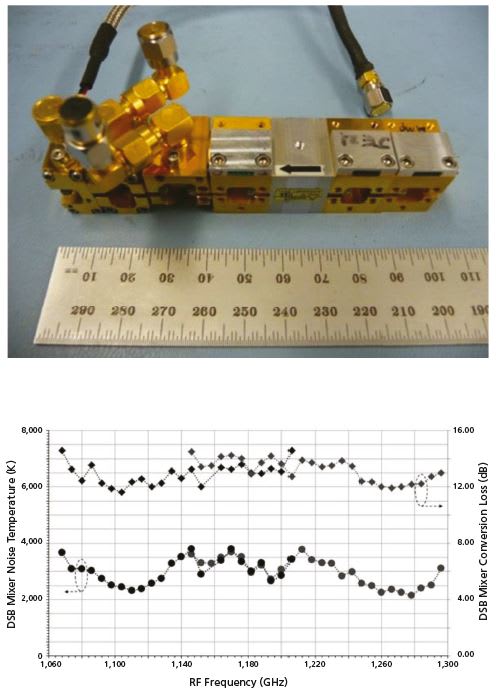
The measured DSB noise temperatures and conversion losses of the receiver are 2,000 to 3,500 K and 12 to 14 dB, respectively, at 120 K, and 4,000 to 6,000 K and 13 to 15 dB, respectively, at 300 K. These results establish the state-of-the-art for all-solid-state, all-planar heterodyne receivers at 1.2 THz operating at either room temperature or using passive cooling only. Since no cryogenic cooling is needed, the receiver is eminently suited to atmospheric heterodyne spectroscopy of the outer planets and their moons.
This work was done by Jose V. Siles, Imran Mehdi, Erich T. Schlecht, Samuel Gulkis, Goutam Chattopadhyay, Robert H. Lin, Choonsup Lee, and John J. Gill of Caltech; Bertrand Thomas of Radiometer Physic; and Alain E. Maestrini of Observatoire de Paris for NASA’s Jet Propulsion Laboratory. NPO-48896
This Brief includes a Technical Support Package (TSP).
An All-Solid-State, Room-Temperature, Heterodyne Receiver for Atmospheric Spectroscopy at 1.2 THz
(reference NPO-48896) is currently available for download from the TSP library.
Don't have an account?
Overview
The document discusses the development of advanced heterodyne receivers for planetary science missions, particularly focusing on the upcoming European Space Agency's Jupiter Icy Moons Explorer (JUICE) mission. It emphasizes the necessity of these receivers for studying the atmospheres of outer planets and their moons, highlighting the challenges posed by long-distance space missions that make cryogenic cooling impractical.
The primary focus is on the creation of all-solid-state receivers operating at 600 GHz and 1.2 THz, which are crucial for the Submillimeter-Wave Instrument (SWI) on the JUICE mission. The document outlines two main objectives for the fiscal years 2011 and 2012: the development, fabrication, and testing of heterodyne receivers at both frequencies. These receivers are designed to be compact, broadband, radiation-hard, and efficient in terms of mass and power consumption, without compromising performance.
A significant innovation presented is the 1.2 THz local oscillator (LO) source, which includes a W-band power amplifier, a frequency-multiplied LO, and a subharmonic mixer. This receiver is notable for being the first all-solid-state tunable room-temperature heterodyne receiver beyond 1 THz, enabling terahertz spectroscopy in the atmospheres of outer planets and their moons. The document also mentions that these receivers can operate without the need for cryogenic cooling, achieving record performance expected to improve at lower temperatures.
The applications of these compact and broadband radiometers extend beyond the JUICE mission, playing a vital role in various NASA missions aimed at studying atmospheric chemistry, global radiation balance, and the search for extraterrestrial life signatures. The document highlights the importance of high-resolution submillimeter-wave spectrometers in understanding the thermal structure, composition, and dynamics of planetary atmospheres.
In conclusion, the document outlines the ambitious goals of developing state-of-the-art heterodyne receivers that will enhance our understanding of outer planetary atmospheres and contribute significantly to future NASA missions. The successful implementation of these technologies is expected to provide valuable insights into atmospheric phenomena and the potential for life beyond Earth.