

A system has been developed using sound to detect problems on rovers or other remote platforms autonomously. It consists of a sensor array of microphones and accelerometers that uses the differences in the sounds generated by the motors, gears, instruments, or other devices being monitored to determine abnormal operation conditions.
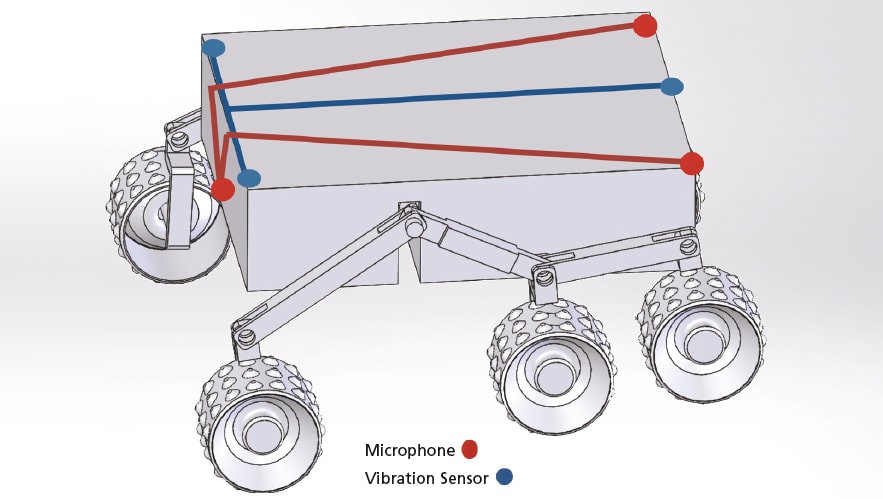
In general, to locate a sound source in a given volume requires at least three sensors. In the case of a vehicle, however, a combination of vibration sensors needs to be used to monitor the amplitude of local vibrations in the structure. The microphones monitor the local pressure changes in the atmosphere to determine the noise location. The arrangement could be simple with three accelerometers and three microphones. Ideally, the microphones would be decoupled from local vibrations in the support structure to reduce interference of structure vibrations.
A series of accelerometers and microphones is attached to the mobility platform’s mechanical subsystems, chassis, suspension, wheel mounts, mast, instrument deployment device, etc. The sensors monitor ambient sound and record what it sounds like to drive on Mars, for example, and also transmit to Mission Operations sounds that are abnormal or may have destructive implications (grinding, fractures, pops, etc.) that can be analyzed and potentially processed by using the waveforms from a variety of the sensors to determine the location of the source.
Traditional accelerometers are made from piezoelectric materials by fixing the piezoelectric to the body of the sensor and attaching a reaction mass to the other surface. As the sensor is accelerated, the reaction mass produces a force on the piezoelectric, and charge is generated. These simple accelerometers can act as vibration sensors and be distributed at pre-determined locations to allow for the localization of the noise source via timing the acoustic signal in the structure.
In addition, the system could be used to determine the ground integrity and hardness as well as ambient winds. This system could be used to create another dimension in planetary exploration. Current rover systems have a plethora of cameras and imagers. Of the five senses that a human uses to explore, sound can be used to determine a variety of information on a faraway planet and assist in diagnosis of potential problems in a reliable manner.
This work was done by Stewart Sherrit, Xiaoqi Bao, Yoseph Bar-Cohen, and Phillip E. Walkemeyer of Caltech for NASA’s Jet Propulsion Laboratory. NPO-49405
This Brief includes a Technical Support Package (TSP).
Microphones and Accelerometer Sensors Network for Acoustic Diagnostics (MASNAD)
(reference NPO49405) is currently available for download from the TSP library.
Don't have an account?
Overview
The document outlines the development of a Microphones and Accelerometer Sensors Network for Acoustic Diagnostics (MASNAD) by NASA's Jet Propulsion Laboratory (JPL). This innovative system is designed to monitor vibrations and sounds in complex systems, such as rovers used in planetary exploration. The primary goal is to diagnose potential issues in mechanical subsystems by analyzing the noise generated by components like motors, gears, and joints, similar to how a mechanic listens for problems in a car.
The MASNAD system employs a network of inexpensive, high-accuracy sensors distributed across various parts of the rover. These sensors include microphones to capture ambient sounds and accelerometers to monitor vibrations. By analyzing the data collected, the system can identify normal operational sounds and detect anomalies that may indicate mechanical failures, such as grinding or fractures.
One of the key features of the system is its ability to localize sound sources. By using multiple sensors, the system can determine the relative position of sound peaks, which helps pinpoint the location of potential issues. This capability is enhanced by comparing recorded sounds to libraries of normal operational sounds from Earth, aiding in the diagnosis and characterization of the rover's performance on other planetary bodies, such as Mars.
The document also discusses the technical aspects of the system, including the arrangement of sensors to minimize interference from structural vibrations. It emphasizes the importance of having both microphones and accelerometers to provide a comprehensive understanding of the rover's operational environment.
In addition to its applications in planetary exploration, the MASNAD system has potential terrestrial applications, such as in automobiles, where it could be used to monitor performance and detect failures based on sound analysis.
Overall, the MASNAD project represents a significant advancement in acoustic diagnostics, combining innovative sensor technology with practical applications for both space exploration and everyday vehicles. The research is supported by NASA and aims to enhance the safety and efficiency of robotic missions on other planets while providing insights that could benefit various industries on Earth.










