

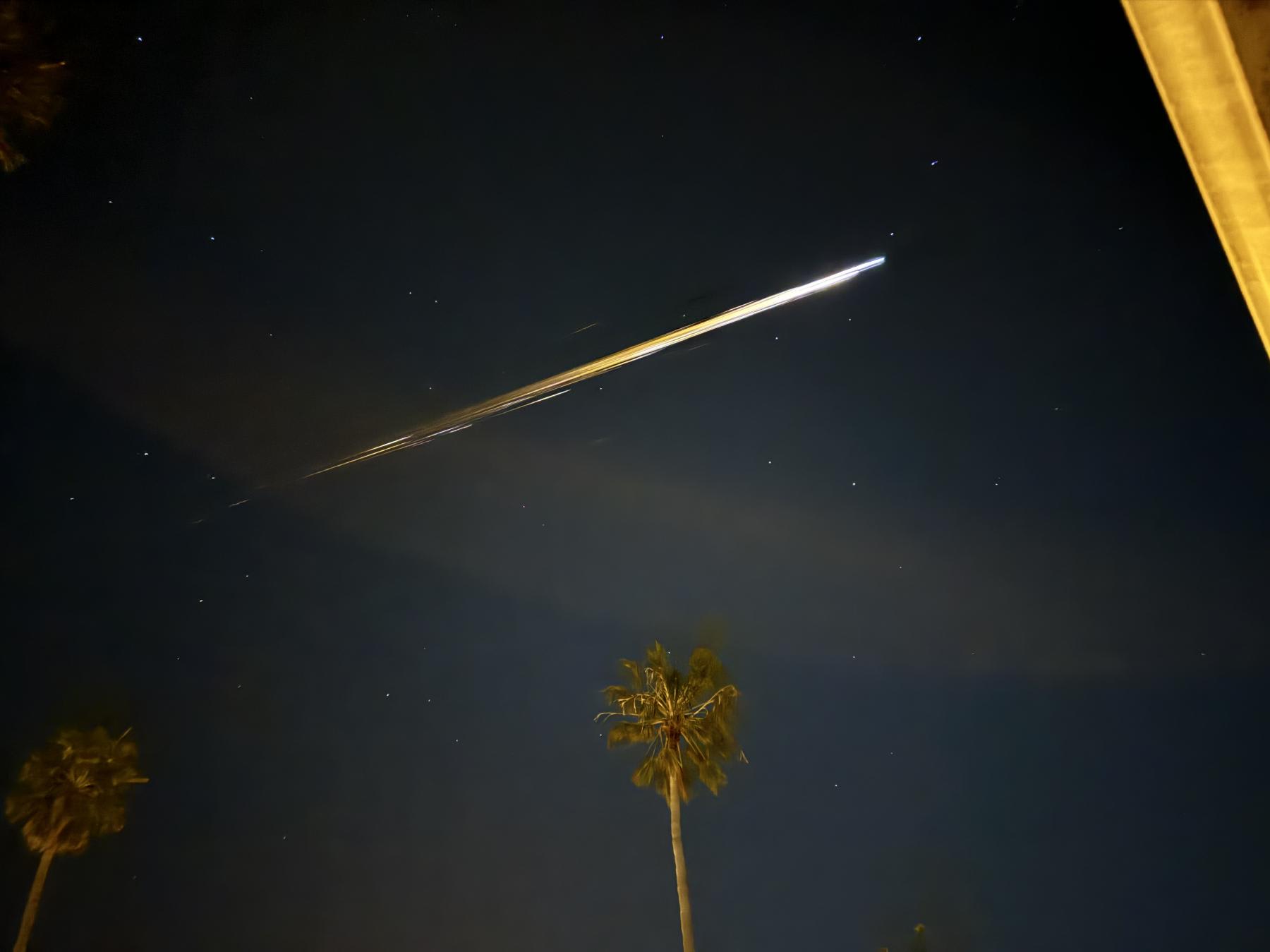
Space debris — the thousands of pieces of human-made objects abandoned in Earth's orbit — poses a risk to humans when it falls to the ground. To locate possible crash sites, a Johns Hopkins University scientist has helped to devise a way to track falling debris using existing networks of earthquake-detecting seismometers.
The new tracking method generates more detailed information in near real-time than authorities have today — information that will help to quickly locate and retrieve the charred and sometimes toxic remains.
"Re-entries are happening more frequently," said Lead Author Benjamin Fernando, a postdoctoral research fellow who studies earthquakes on Earth, Mars, and other planets in the solar system. "Last year, we had multiple satellites entering our atmosphere each day, and we don't have independent verification of where they entered, whether they broke up into pieces, if they burned up in the atmosphere, or if they made it to the ground. This is a growing problem, and it's going to keep getting worse."
Here is an exclusive Tech Briefs interview, edited for length and clarity, with Constantinos Charalambous, a research fellow at Imperial College London.
Tech Briefs: What was the biggest technical challenge you faced while developing this tracking method?
Charalambous: Detecting the boom isn’t the hard part — interpreting it is. A reentry is a moving, evolving source, so the data from any single station can look ambiguous. You don’t get one clean "bang": the atmosphere refracts and distorts the wave, you can get multipathing, coupling into the ground varies from site to site, and stations have very different noise floors. Fragmentation adds extra arrivals on top of that, and those are often weaker than the main Mach-cone signal.
So, the core technical challenge is disentangling source physics from propagation and site effects — recovering a stable geometric constraint on the trajectory and breakup behavior without overfitting all the messy details in the waveforms. That’s exactly why the network matters: One station can mislead you, but a network lets the geometry "win" and constrain the solution. And such a network is also what makes it possible to pull out subtle, coherent breakup-related signals that are buried inside the dominant incoherent variability and noise.
Tech Briefs: Can you explain in simple terms how it works please?
Charalambous: A hypersonic object produces a shock wave, like a moving sonic boom as it travels through the atmosphere. When that airwave hits the ground it “thumps” the surface, and sensitive seismometers record the resulting tiny ground motion. With many stations, the pattern of arrival times is like a fingerprint of the flight path. We invert that fingerprint to reconstruct the direction of travel and speed, and then we use coherence-based stacking to pull out weaker, short sub-second bursts that line up across a subset of stations, which we interpret as discrete breakup events during a rapid fragmentation sequence. Essentially, the shock wave draws a moving pattern on the ground; we match the pattern back to the trajectory.
A useful analogy is a field of microphones. A seismometer is like a very sensitive microphone bolted to the ground. A reentering object is moving at Mach 25–30 and continuously generating a Mach cone. As that cone sweeps across the surface, microphones close to the ground track, nearest to the flight line, "hear" the boom at nearly the same time because the boom is sweeping along with the object, while microphones off to the side hear it later because the sound has to travel sideways through the atmosphere at roughly the speed of sound. So, if you map those arrival times across the network, the trajectory appears as a corridor in the timing pattern — and that’s what we invert to recover the path. One station can tell you "something happened"; a network lets you reconstruct where it went and how it evolved.
Tech Briefs: Do you have any set plans for further research/work/etc.?
Charalambous: Our immediate next step is moving from a successful demonstration to an operationally useful pipeline: more automation, more robust uncertainty estimates, and testing across a larger set of reentries under different atmospheric conditions and with different station densities (including sparser networks). The goal is a fast, repeatable workflow that can run anywhere there are seismic stations across the globe, turning existing ground networks into a practical tool for space-safety decision-making.
A second direction is sensor fusion: combining seismic constraints with other open data streams such as optical observations and infrasound (and any available tracking) to tighten uncertainty further and provide a more complete picture of "what happened in the atmosphere." In parallel, there’s a scientific next step: using more events to link observed breakup timing patterns to physical models of disintegration (which components fail when, and what that implies for survivability). That feeds directly into better hazard assessment and "design-for-demise" strategies.
Finally, we’re careful to be clear: this won’t beat physics (sound takes time to arrive), so it’s not a “take-cover” siren, but it can shrink uncertainty quickly once the first signals are recorded, which is exactly what aviation and response teams need.
Tech Briefs: Is there anything else you’d like to add that I didn’t touch upon?
Charalambous: Basically, our method helps turn the part of "we’re not sure where it went" into an evidence-based corridor. Uncontrolled reentries are usually low risk to any one person, but as Earth’s orbits get more crowded (at a near exponential rate), the number of reentries is rising, so reducing uncertainty quickly is only going to matter more. We therefore need every practical tool we can add to the toolkit.
Two things are worth stressing. First, this isn’t just "we detected a sonic boom". The exciting part is that, in good cases, the network contains a structured breakup story. Those sub-second timing patterns provide a new observational constraint on how spacecraft actually disintegrate at hypersonic speeds — something we often have to model but rarely observe directly — and it’s exactly the kind of input risk that models usually have to assume rather than measure.
Second, this is designed to complement existing tracking, not replace it. Radar and optical data are extremely powerful, but the messy and chaotic breakup phase is where information can become patchy or difficult to interpret. Seismic networks are passive, ground-based, widely distributed, and independent, so they can provide a complementary layer of evidence about what happened in the atmosphere.













